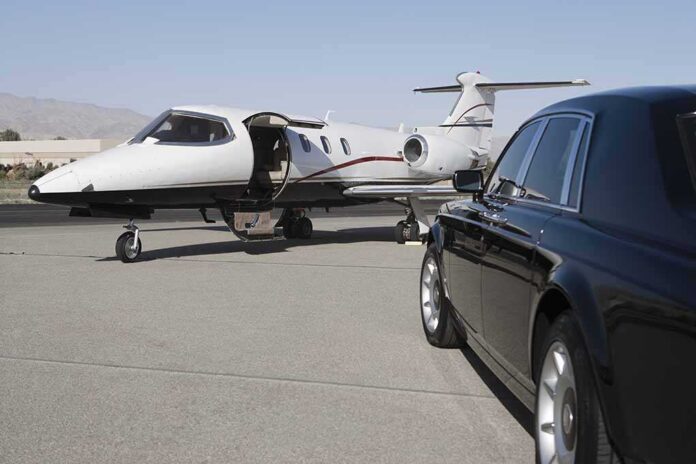
Roughly 500 private jets reportedly flooded out of the Bay Area after Super Bowl LX—handing Sen. Mike Lee a pointed question about whether the loudest climate scolds live by their own rules.
Story Snapshot
- Flight-tracking data cited by Flightradar24 showed a 1,136% spike in business-jet departures from five Bay Area airports after Super Bowl LX.
- Sen. Mike Lee (R-UT) highlighted the post-game private-jet “exodus” and questioned how many passengers were “climate alarmists.”
- Reports indicated heavy inbound private-jet traffic before kickoff, underscoring the Super Bowl’s pull for VIP travel.
- Federal agencies ran elevated security operations around Levi’s Stadium, reflecting the event’s high-profile risk environment.
Flight-Tracking Data Shows a Post-Game Private-Jet Rush
Flightradar24 data cited in coverage described an unusual surge in business-jet departures from five Bay Area airports—San Francisco (SFO), San Jose (SJC), Oakland (OAK), Livermore (LVK), and Hayward (HWD)—in the hours after Super Bowl LX on February 8, 2026. The figure highlighted was a 1,136% increase in departures compared with the prior Sunday. The same reporting framed the moment as an immediate post-game “exodus” rather than a gradual tapering of traffic.
That spike matters because it is measurable, not rhetorical. Flight-tracking platforms compile ADS‑B and related signals to map takeoffs and landings in near real time, which means the departure surge can be discussed as a logistical fact even while motives remain unknown. What cannot be confirmed from the available reporting is the political identity, climate views, or specific passenger lists of those travelers—only that business jets left in far higher numbers than a typical Sunday night.
Sen. Mike Lee Puts “Climate Alarmists” Under the Microscope
On February 9, Sen. Mike Lee used X to spotlight the jet traffic and ask how many of the passengers on those departing jets were “climate alarmists.” His post, as described in the reporting, leaned on the contrast between celebrity-and-elite lifestyles and the public messaging that often demands higher costs, restrictions, and behavioral changes for average Americans. The question resonated online precisely because the underlying data point—mass departures—was concrete, even if the target group was implied.
Based on the sources provided, Lee’s comment functions as political critique rather than a documented allegation against specific individuals. No outlet cited here identified named passengers, and no official manifest-based accounting was presented. Still, the episode taps into a broader frustration among many conservatives: climate policy debates routinely focus on controlling everyday life—energy prices, home heating, vehicle choices—while high-end travel and luxury consumption often appear insulated from sacrifice. The public sees one set of rules for “connected” people and another for everyone else.
Inbound Jet Traffic and a Super Bowl Built for VIP Logistics
Coverage also pointed to heavy inbound private-jet activity before kickoff, with local reporting showing jets lined up at Bay Area airports. That pre-game buildup helps explain how a large post-game departure rush could happen in a short window: the region has multiple airports within close range of Levi’s Stadium, and high-net-worth travelers often prefer point-to-point aviation over commercial terminals. The story is less about one runway and more about a metro area capable of absorbing and releasing VIP traffic quickly.
The entertainment and cultural context around Super Bowl LX added another layer to the online debate. Reporting noted performers and surrounding commentary that, in other venues, has leaned into progressive political messaging. That may shape perceptions about who attends these events and what viewpoints dominate the “VIP class,” but it does not prove anything about individual passengers on any specific aircraft. The verifiable center of gravity remains the flight-tracking numbers and the observable reality of large-scale private aviation around marquee sports events.
Security Operations Highlight the Size and Stakes of the Event
Separate reporting described elevated federal security measures tied to Super Bowl operations in Santa Clara. With major events frequently designated at high security levels, aviation monitoring becomes part of a wider safety posture that can include helicopter assets and surveillance aimed at detecting drone threats or other hazards. For the public, that detail underscores how the Super Bowl is not just a football game—it is a national-scale operation, with layered coordination that has implications for airspace, local infrastructure, and taxpayer-funded resources.
From a conservative lens, the takeaway is not that security is unnecessary, but that the same government and cultural institutions that lecture Americans about carbon footprints and “equity” still support a high-dollar ecosystem that runs on elite access and heavy resource use. The available sources do not establish hypocrisy in a provable, person-by-person way—but they do document an unmistakable pattern: when the biggest party in America ends, the private jets don’t trickle out. They stampede.
Sen. Mike Lee Has a Question About the MASSIVE Number of Private Jets Leaving S.F. After the Super Bowl https://t.co/rG4vhMPciT
— Twitchy Updates (@Twitchy_Updates) February 9, 2026
For policymakers, the moment is a reminder to separate measurable facts from political assumptions. The fact pattern documented here is the surge in departures and the senator’s question. Whether the incident changes climate politics is unclear, but the optics are easy to understand: Americans who endured years of inflation and regulatory pressure have little patience for lectures that don’t seem to apply to the people delivering them. With trust already strained, these high-visibility contradictions—real or perceived—keep fueling the backlash.