
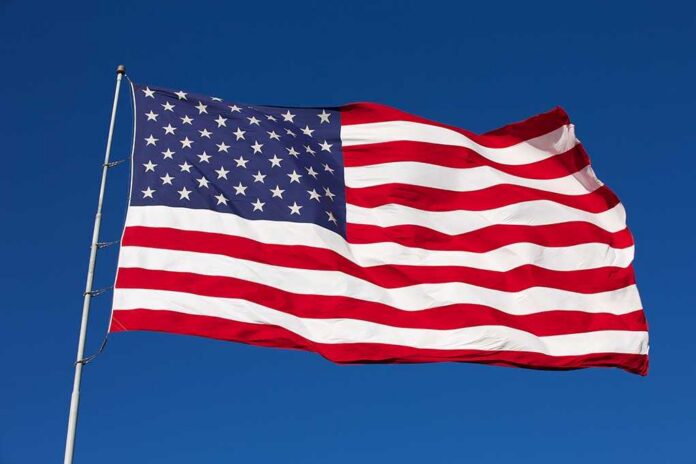
After seven years of diplomatic freeze, the American flag is flying again in Caracas—signaling a major U.S. leverage win in the hemisphere and a test of whether Washington can protect its interests without repeating the old mistakes of weak foreign policy.
Story Snapshot
- U.S. embassy staff raised the American flag in Caracas on March 14, 2026, for the first time since relations collapsed in 2019.
- The flag was hoisted at the same time it was lowered seven years earlier, underscoring a deliberate, symbolic reset.
- The reopening follows the January 2026 U.S. military operation that captured Nicolas Maduro, now facing drug trafficking charges in New York.
- The Trump administration has moved quickly with new energy and mining agreements as Venezuela’s interim government seeks broader sanctions relief.
Flag Raised in Caracas Marks a Precise Diplomatic Reversal
U.S. embassy staff in Caracas raised the American flag on March 14, 2026, restoring a public symbol absent since Venezuela severed diplomatic relations in March 2019. The timing was exact: the flag went up at the same time it came down seven years earlier, a detail that highlights how intentionally Washington and embassy leadership framed the moment. U.S. Charge d’Affaires Laura Dogu described the shift as the start of “a new era.”
The immediate significance is practical as well as symbolic. Reopening diplomatic channels gives the U.S. a direct presence for negotiations, security coordination, and on-the-ground reporting—tools that disappear when relations break. For Americans tired of global chaos being managed by press releases and “summits,” the return of a functioning embassy signals a more concrete approach: show up, establish leverage, and keep U.S. interests at the center of the relationship.
How the 2019 Break Happened—and What Changed in 2026
Relations unraveled after Nicolas Maduro’s disputed 2018 re-election. The United States refused to recognize the result, citing concerns over democratic legitimacy, and Venezuela responded by cutting ties with Washington in 2019. That decision closed official channels and hardened the standoff for years. The political landscape shifted sharply in January 2026 when a U.S. military operation captured Maduro and flew him to New York to face drug trafficking charges.
That single event removed the main barrier identified in the reporting: Maduro’s continued rule and the dead-end legitimacy fight that came with it. With Maduro out of power, Caracas moved under interim leadership, and both sides reopened diplomatic relations in early March 2026. The sequence matters because it shows normalization did not occur as a vague “reset.” It followed a major enforcement action and a forced change in political reality inside Venezuela.
Energy and Mining Deals Put U.S. Interests Front and Center
Diplomacy is not reopening in a vacuum. The Trump administration has already signed new energy and mining agreements with Venezuela’s interim leadership aimed at opening those sectors to private investment. That emphasis tracks with Venezuela’s vast oil reserves and the long-standing strategic importance of access to supply. With relations frozen, bilateral engagement stalled and American companies were blocked from meaningful participation in Venezuela’s resource economy.
Sanctions policy is also shifting, but unevenly. The interim government under Delcy Rodriguez has publicly called on Washington to fully lift sanctions, while some sanctions have reportedly been eased since January to allow multinational companies limited licenses to resume operations. Those details suggest negotiations will center on how much relief comes, how fast, and under what conditions. The available research does not provide the specific terms of the new agreements or the exact scope of sanction changes.
What This Means for Regional Stability—and Where the Risks Remain
Restored relations can reshape regional geopolitics by changing how neighboring governments calculate U.S. influence in Latin America. A reopened embassy and active negotiations also create a path for more predictable communication, which can reduce miscalculation during a transition. In the short term, the reporting indicates three clear effects: formal diplomatic presence returns, limited business activity resumes under licensing, and the interim government gains international legitimacy.
Longer term, expanded access to oil reserves could support U.S. energy security by diversifying supply, while private investment could help Venezuela’s economy recover if governance and management are competent. However, the research includes no independent expert commentary, polling, or detailed public reaction from Venezuelans, so claims about how ordinary citizens view the normalization cannot be verified from the provided material. What is clear is that sanctions relief and investment terms will be the central pressure points going forward.
The flag-raising is a reminder that symbols follow power, not the other way around. For Americans who watched years of foreign-policy drift, the Caracas reopening shows a different posture: enforce, negotiate, and use economic leverage to protect U.S. interests. The next question is whether the diplomatic reset stays anchored to measurable outcomes—security cooperation, transparent investment rules, and clear conditions for sanctions relief—or whether it slides back into open-ended engagement without accountability.
Sources:
US-Venezuela relations ease after Maduro capture: US flag raised at embassy in Venezuela