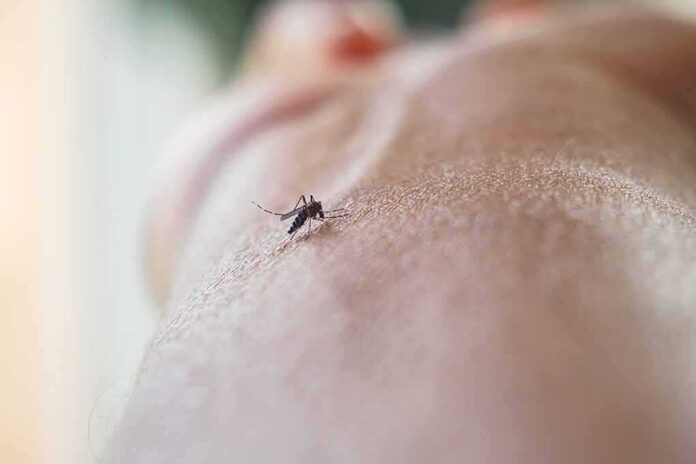
Not a single person in a 119-volunteer test attracted all three major mosquito species, showing that each species has its own “type.”
Story Highlights
- Florida International University researchers found species-specific attraction across 119 people.
- Aedes albopictus leaned toward people with more ketone odors; other species preferred lower overall skin odor.
- Skin bacteria patterns tracked with which species showed up, pointing to a microbiome link.
- Some shared odor cues still mattered across species, so preferences are distinct but not absolute.
What The Study Actually Found
Florida International University scientists tested 119 human volunteers against three common mosquito species using a controlled odor device. The team measured how many females of Aedes aegypti, Aedes albopictus, and Culex quinquefasciatus were attracted to each person’s scent. The headline result was simple and striking: no participant attracted all three species. That pattern supports species-specific preferences instead of a universal “mosquito magnet” idea, at least under lab scent-only conditions. The findings appear in the journal iScience.
The researchers used a uniport olfactometer to present each person’s odor to each mosquito species and then recorded attraction rates. This design let them compare how the same person ranked across species. The study reported that Aedes albopictus tended to favor people with higher levels of ketones. Aedes aegypti and Culex quinquefasciatus leaned toward people with less overall skin odor. These patterns fit earlier work showing that smell guides host seeking in different ways across species.
How Skin Odor And Bacteria Shape Attraction
Human skin gives off hundreds of compounds. Skin bacteria break down sweat and oils into new smells that insects can detect. In this study, certain bacteria tracked with attraction for specific species. Aedes aegypti linked with higher Staphylococcus levels. Aedes albopictus linked with microbes like Streptococcus intermedius and Anaerococcus octavius. Culex quinquefasciatus showed its own bacterial ties. These are associations, not proof of cause, but they match a growing body of research on the skin microbiome and mosquito behavior.
Not every signal was species-unique. Some odor cues were shared. All three species were more drawn to participants who emitted more ethyl 2-methylbutanoate and were less drawn to those with more 1-penten-3-ol. That matters for practical use. It hints that targeted repellents or lures could focus on shared compounds to cover many species, while other tools could tune to species-specific chemicals. The study’s data and code are publicly available for deeper review and testing.
Why This Matters For Public Health And Daily Life
Different mosquito species spread different diseases and thrive in different places. Aedes aegypti is a major vector for dengue, Zika, and chikungunya. Aedes albopictus can carry some of the same viruses and is expanding its range. Culex quinquefasciatus can transmit West Nile virus and other pathogens. If species follow different scent rules, health officials can design smarter traps, lures, and repellents that match local threats. That may help cut bites without blanket chemical spraying.
For people who feel like “mosquito magnets,” this research offers a clearer picture. You may be highly attractive to one species but average or low for another. Your skin odor mix and the bacteria that live on your skin may be part of the reason. While this study focused on scent under controlled conditions, it supports everyday advice: reduce standing water, use Environmental Protection Agency-approved repellents, wear long sleeves, and run fans to disrupt flight. These steps work across species, regardless of your natural scent.
Limits, Next Steps, And A Shared Frustration
This study measured attraction to scent in a lab, not biting in the wild, and it used one group of 119 people. Real-world biting also depends on carbon dioxide, heat, movement, clothing, and time of day. Researchers suggest the next phase should test larger, more diverse groups in field settings and run direct microbiome experiments to show cause. The open dataset lets independent teams validate, refine, or challenge the models behind these results.
A new Florida International University study finds each mosquito species is drawn to its own mix of human skin odors, chemicals, and bacteria, challenging the idea of a universal mosquito magnet and pointing toward better repellents. 🦟 pic.twitter.com/sQcl6XP8KV
— Bio DNA (@biodnaa) November 11, 2026
Citizens on both the left and right often feel that the system ignores practical, local health risks. Mosquito-borne disease fits that concern. Cities fight growing mosquito ranges while budgets lag. People pay for sprays that may not match the species near them. Research that maps species-specific preferences can guide better, leaner public health steps. It can help communities protect families with smart targeting, not waste, and with science that anyone can check for themselves.
Sources:
wusf.org, news.fiu.edu, pmc.ncbi.nlm.nih.gov, discovermagazine.com, datadryad.org
© patriotwise.com 2026. All rights reserved.