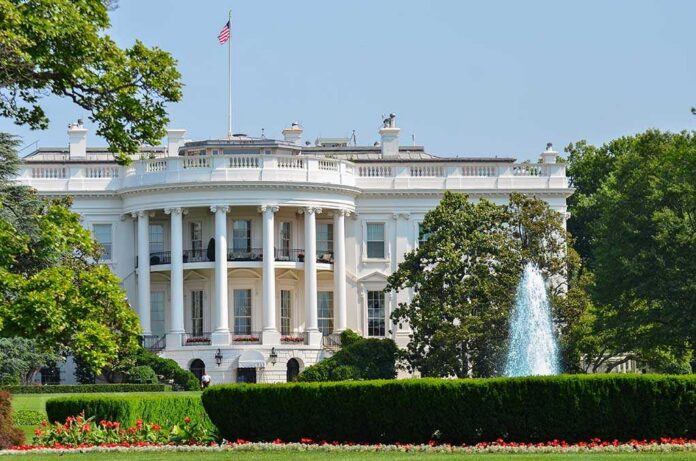
As Americans watch a war unfold overseas, President Trump’s surprise reveal of a “massive” military complex being built beneath a new White House ballroom is raising fresh questions about secrecy, authority, and priorities in an already tense moment.
Quick Take
- President Trump says the U.S. military is constructing a “massive complex” beneath a new White House ballroom now being built.
- Trump says the roughly $400 million ballroom is funded by him and private donors, with “not one dime” of taxpayer money.
- The project includes hard-security features like bulletproof glass and drone-resistant roofs and ceilings, according to reporting.
- A federal judge has questioned Trump’s authority to move forward with the ballroom project, signaling potential legal headwinds.
What Trump Announced, and What’s Actually Under Construction
President Donald Trump said on March 29, 2026 that “the military is building a massive complex under the ballroom,” describing underground work as already underway. The statement came as the White House presses ahead with construction tied to a new ballroom on the East Wing site. Reporting indicates demolition activity began March 24, 2026, as the project moved from planning to active site work and excavation.
Trump’s remarks leave a key detail unanswered: what the underground “complex” is for. The available reporting does not provide technical specifications, square footage, or a defined mission beyond “security” framing and the fact that the military is involved. With the country focused on the Iran war and worries about escalation, that lack of clarity matters because Americans tend to demand straightforward explanations when national-security construction is happening at the people’s house.
Funding Claims: Private Donors, Zero Taxpayer Dollars, and Why People Will Scrutinize It
Trump has said the ballroom’s approximately $400 million cost is being paid by himself and private donors, emphasizing that “not one dime of government money” is going into the ballroom. For fiscally stressed households that have endured inflation and years of Washington overspending, the promise of private funding will sound like a relief. It also invites a basic accountability question: who the donors are and what safeguards exist to prevent influence-buying.
The research available here does not identify the donors or describe the funding mechanisms, and it offers no independent audit or contract documentation. That gap is not proof of wrongdoing, but it is a real limitation in what the public can verify right now. Conservatives who have watched bureaucracies grow unaccountable—often in the name of “emergencies”—will likely insist on transparency that protects taxpayers and preserves public trust in the presidency.
Security Features and the War-Week Mindset in Washington
Reporting describes the ballroom as built with bulletproof glass and drone-proof or drone-resistant roofs and ceilings, underscoring that the project is not simply about hosting larger state events. Those features match today’s threat environment, where drones are cheap, accessible, and increasingly used in conflict zones. Americans watching battlefield footage from the Middle East understand that hardened infrastructure is becoming standard, not exotic, for high-value government targets.
At the same time, the “security first” framing lands differently in 2026 because the country is at war with Iran and many MAGA voters are divided about deeper involvement and what open-ended commitments mean. When leadership promised “no new wars,” the public expects discipline and candor from Washington. Major security expansions at the executive mansion can look prudent, but they can also fuel suspicion that permanent war-footing is becoming normalized.
The Approval Process, the Courts, and the Constitutional Questions
The U.S. Commission of Fine Arts reportedly approved the project in February 2026 by a unanimous 6-0 vote after a fast-tracked review. That matters because it shows the project did pass through at least one formal review body rather than being purely informal or ad hoc. The same reporting also indicates underground construction is described as ahead of schedule and under budget, language voters typically hear when officials want to signal competence and control.
A federal judge has questioned Trump’s authority over the White House ballroom project, but the reporting summarized in the research does not spell out the judge’s specific legal concerns. That missing detail is important: Americans cannot evaluate the strength of the challenge without knowing whether it involves procurement rules, historical preservation, separation-of-powers boundaries, or some other statutory limit. Regardless, judicial scrutiny means the project could face delays or imposed conditions.
What Conservatives Should Watch Next: Transparency, Oversight, and Mission Creep
Several key questions remain unanswered based on current reporting: the purpose and scope of the underground “massive complex,” the identity of private donors, and how oversight will work if military construction is integrated into a civilian event space. In a period when voters are wary of unelected “experts,” runaway spending, and security-state overreach, transparency is not a talking point—it is a constitutional pressure valve that helps keep trust intact.
President Trump Reveals Military Building 'Massive Complex' Under Ballroom https://t.co/b313OEeBeb #gatewaypundit via @gatewaypundit
— BREAKING NEWZ Alert (@MustReadNewz) March 30, 2026
Until more documentation is public, Americans should separate what is confirmed from what is assumed. It is confirmed that demolition and construction are underway, that Trump is describing a military-built underground component, and that enhanced security features are part of the plan. It is not confirmed—based on the research provided—what the underground complex will do or how far presidential authority extends here. Those details will determine whether this becomes a model of private-funded modernization or a new flashpoint over accountability.
Sources:
Trump Reveals Military Building “Massive Complex” Beneath White House Ballroom
Trump claims donor funded White House ballroom includes hidden build below security focus