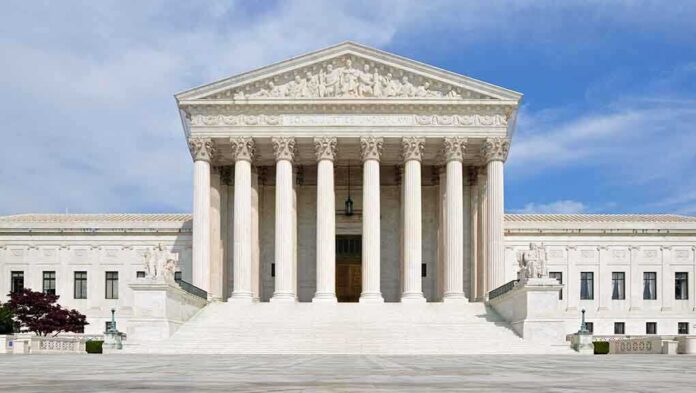
A landmark Supreme Court case threatens First Amendment rights, raising alarms over nonprofit donor privacy.
Story Highlights
- The Supreme Court is evaluating a case involving nonprofit donor privacy and potential overreach by state authorities.
- New Jersey’s Attorney General has subpoenaed a pro-life center, demanding donor information from the past decade.
- The case follows a recent precedent where the Supreme Court protected donor privacy against state demands.
- Conservative groups argue the subpoena undermines First Amendment rights and could set a dangerous precedent.
Supreme Court Examines Donor Privacy
On December 2, 2025, the U.S. Supreme Court heard arguments in *First Choice Women’s Resource Centers, Inc. v. Platkin*. This pivotal case questions whether states can force nonprofits to reveal donor identities. The case arose after New Jersey Attorney General Matthew Platkin issued a subpoena to First Choice, a network of pro-life pregnancy centers, demanding ten years of donor identities and internal records.
The case is particularly significant as it challenges the balance between state consumer protection powers and the constitutional rights of association and privacy. The outcome could either reinforce or erode the protective barriers around nonprofit donor identities, a fundamental First Amendment concern.
Background and Legal Precedent
The roots of this legal battle trace back to the Supreme Court’s 2021 decision in *Americans for Prosperity Foundation v. Bonta*. In that case, the Court struck down California’s law mandating donor disclosures, setting a precedent that governments cannot indiscriminately collect donor information without demonstrating necessity. This precedent directly contradicts New Jersey’s current approach.
Attorney General Platkin argues the subpoena is a consumer protection measure, claiming First Choice might mislead donors. However, First Choice’s legal team asserts that the center’s pro-life mission is clearly communicated, rendering the deception claim baseless. This case highlights ongoing tensions between state regulations and constitutional rights.
Implications and Possible Outcomes
The Supreme Court’s decision will have far-reaching implications. A ruling favoring First Choice could fortify donor privacy nationwide, safeguarding nonprofits from intrusive state demands. Conversely, a ruling against them could embolden states to pursue similar subpoenas, potentially chilling donor support for organizations facing political scrutiny.
Will the Supreme Court uphold the privacy of nonprofit donors? https://t.co/3mUfFb5GjZ
— Politomix (@PolitomixNews) December 2, 2025
The decision will influence not only pro-life centers but also a wide range of nonprofits engaged in advocacy. The broader political landscape, already charged with ideological battles over abortion rights post-Dobbs, underscores the case’s significance, with potential impacts on both state regulatory practices and individual donor protections.
Sources:
Washington Times on Supreme Court Case
Institute for Free Speech Analysis