
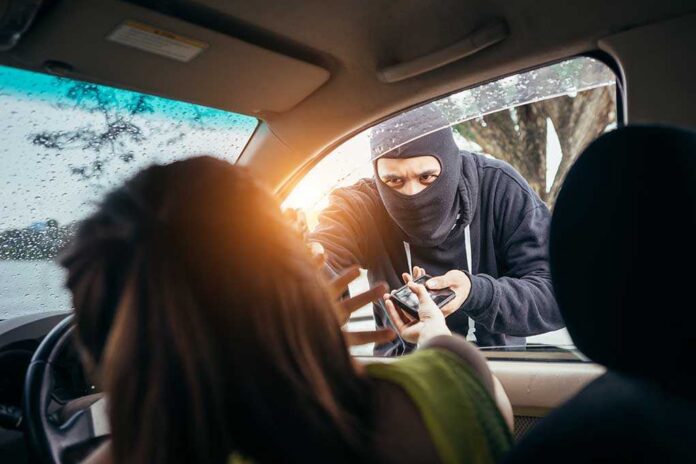
A Garland father’s split-second decision to shoot a carjacker—while his family of eight sat inside the targeted vehicle—has reignited the blunt question many Americans keep asking: when government can’t stop violent crime in real time, who protects your kids?
Quick Take
- Garland police say a Texas father acted in self-defense after a man tried to carjack his vehicle with his family inside.
- Surveillance video shows a roughly minute-long struggle as the suspect forced his way into the driver’s seat and attempted to drive off.
- Police reported no weapon was recovered from the suspect, but investigators believe he attempted multiple carjackings by force that day.
- The case underscores why Texans emphasize personal security and lawful self-defense, especially around families in public parking lots.
What Happened in Garland—and Why Police Considered It Self-Defense
Garland police said the shooting happened Sunday afternoon in a parking lot near Highway 66 and Dairy Road, after a man attempted to steal a vehicle occupied by a family of eight. Surveillance footage shows the suspect confronting the father, forcing himself into the driver’s seat, and struggling for nearly a minute to take control. The father remained outside near the passenger side and fired, killing the suspect, as the vehicle was being taken.
Garland PD indicated the father is not expected to face charges, describing the incident as self-defense during a fast-moving confrontation. Investigators said no weapon was recovered from the suspect, but officers believe he had tried to take other vehicles by force earlier that same day. Police also noted that most of the family inside the vehicle appeared unaware of the struggle until the moment turned deadly, and the family ultimately left unharmed.
Force Without a Weapon Still Creates a Deadly Risk
The absence of a recovered weapon has become a predictable flashpoint in public debate, but the surveillance video and police summary point to a key reality: carjacking by force can quickly become lethal, especially when children are present and a vehicle is in motion. A driver being displaced or dragged, a child caught in a seatbelt, or a panicked acceleration can turn a theft into a fatal event. In that context, “unarmed” does not automatically mean “not dangerous.”
Texas law broadly allows deadly force when someone reasonably believes it is immediately necessary to prevent serious harm, including while protecting others. That legal framework matters because carjackings occur at close range, with little time for deliberation or reliance on law enforcement. For many conservative voters, the Garland case functions less as a culture-war talking point and more as a concrete example of why self-defense rights are treated as a practical safeguard, not an abstract ideology.
A Wider Crime Pattern Behind One Parking-Lot Encounter
Investigators said the suspect appeared to be moving from victim to victim, attempting multiple vehicle thefts by force on the same day. That “spree” pattern mirrors other Texas cases in which carjackings escalate rapidly, leaving families with seconds to respond. Separate incidents around the state have included victims killed at gas stations and near schools, reinforcing a troubling trend: public spaces that used to feel routine—errands, pickups, parking lots—are increasingly where violence erupts.
What This Reveals About Trust, Safety, and the Limits of the State
The political subtext is difficult to ignore in 2026. Republicans control Washington, Democrats remain entrenched in opposition, and many voters across the spectrum still feel the federal government struggles with basic competence. Local crime, however, is where that frustration becomes personal. Police can investigate after the fact, but they are rarely positioned to prevent a sudden attack in a parking lot. The Garland outcome—family safe, suspect dead—will be cited by supporters as proof that lawful self-reliance sometimes fills the gap.
At the same time, the case also highlights why clearer public understanding of self-defense standards matters. The decision to fire is irreversible, and video evidence will shape how communities judge reasonableness, restraint, and necessity. Garland police have not released the suspect’s identity as of the most recent reporting, and investigators are still sorting out the alleged earlier attempts. For families watching the footage, the takeaway is simpler: the threat can arrive with no warning, and the consequences unfold in under a minute.
Sources:
Garland crash: Attempted carjacking self-defense (Fox 4 News)
Texas father fatally shoots man trying to carjack vehicle with family inside (Washington Times)