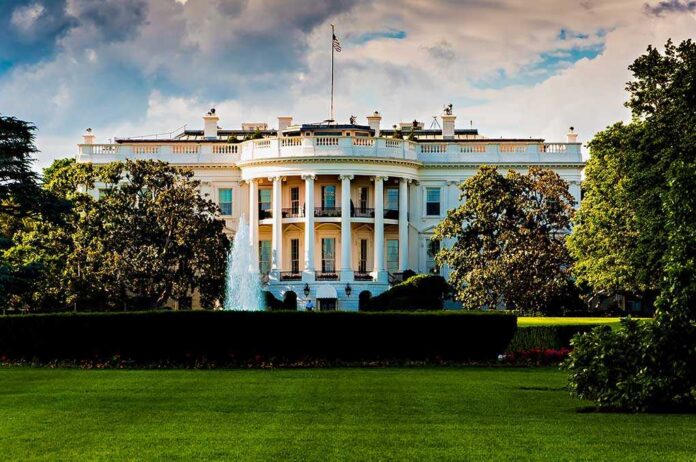
A federal judge’s warning that “no statute” grants the president the authority he claims is now colliding with President Trump’s push to permanently reshape the White House.
Story Snapshot
- The U.S. Commission of Fine Arts unanimously approved a $400 million White House ballroom plan on Feb. 19, 2026, after the East Wing had already been demolished.
- Public feedback ran overwhelmingly against the project, with reporting citing 99% of roughly 2,000 comments opposing it.
- On March 31, 2026, Judge Richard Leon temporarily paused work, signaling major legal doubts about presidential authority to proceed.
- The fight now blends historic preservation, executive power, and accountability for how federal property is altered under a second-term Trump administration.
Fine Arts Approval Collides With Court-Ordered Pause
Washington’s approval-and-lawsuit clock moved fast. The U.S. Commission of Fine Arts voted unanimously on Feb. 19, 2026, to approve construction of a new White House ballroom on the site of the demolished East Wing, with the project price described at $400 million. That vote did not end the controversy. On March 31, 2026, U.S. District Judge Richard Leon granted a temporary pause on work while the underlying legal arguments are reviewed.
Judge Leon’s quoted line—“No statute comes close to giving the President the authority he claims to have”—is the central legal pressure point. Supporters of limited government will recognize why that matters: big personalities come and go, but precedents around executive power stick. If courts ultimately reject the legal basis for the renovation, the administration may face a choice between narrowing the project, pursuing clearer authorization, or risking a deeper separation-of-powers showdown.
A Project Years in the Making, Now Larger and More Expensive
President Trump’s ballroom ambition predates his return to the Oval Office. Reporting ties the effort back to at least 2010, when he raised the idea during the Obama era without success. After Trump announced plans in 2025, the design and scale shifted repeatedly. The cost estimate rose from roughly $200 million to $400 million, and capacity targets expanded, with reporting describing multiple figures across iterations as the scope grew and the plan matured.
The physical reality changed most dramatically in late October 2025, when the East Wing was demolished despite earlier claims that a ballroom would be built near it, not touching it. The project team then saw internal turmoil. Lead architect James McCrery stepped down in early December 2025 amid disagreements over further increases in size. Architect Shalom Baranes replaced him, and construction and engineering firms—including Clark Construction and AECOM—were identified as part of the buildout effort.
Public Opposition vs. Appointed Power Inside Federal Agencies
The approval process revealed a widening trust gap between Washington’s appointed bodies and the public. Reporting states 99% of approximately 2,000 public comments opposed the development, yet the Commission of Fine Arts still voted unanimously to approve it. The commission’s makeup also drew attention: it was described as comprised entirely of Trump appointees, including his executive assistant. That combination—near-total public opposition and unified approval—feeds skepticism about whether “public comment” functions as a meaningful check.
Conservative voters who spent years watching bureaucracies ignore their concerns are not wrong to ask whether the same system now ignores other Americans in reverse. The principle is bigger than party: if agencies can treat overwhelming public input as a box-checking exercise, distrust becomes the default. At the same time, because the White House is both a working federal facility and a national symbol, changes to its footprint raise legitimate questions about process, preservation rules, and who truly has final authority.
What the Legal Fight Means for Executive Power—and for Trump’s Coalition
The lawsuit brought by the National Trust for Historic Preservation seeks to halt the project, and Judge Leon’s temporary pause signals that the judiciary is taking the challenge seriously. The practical impact is immediate—construction delays and uncertainty around the summer 2028 completion target. The constitutional impact could be larger: if a court defines limits on what a president can alter on federal historic property without clearer statutory authority, future administrations could face tighter constraints.
Politics is layered over everything. In 2026, many MAGA-aligned voters are already split and exhausted over foreign-policy questions and the risk of new wars, and they are also wary of spiraling costs at home—especially when energy prices and inflation still bite. Against that backdrop, a $400 million, high-profile renovation invites scrutiny from supporters who want the administration focused on core promises and tangible national priorities, not headline-grabbing projects vulnerable to court intervention.
Sources:
White House Trump Ballroom East Wing
Statement on the proposed ballroom addition at the White House