

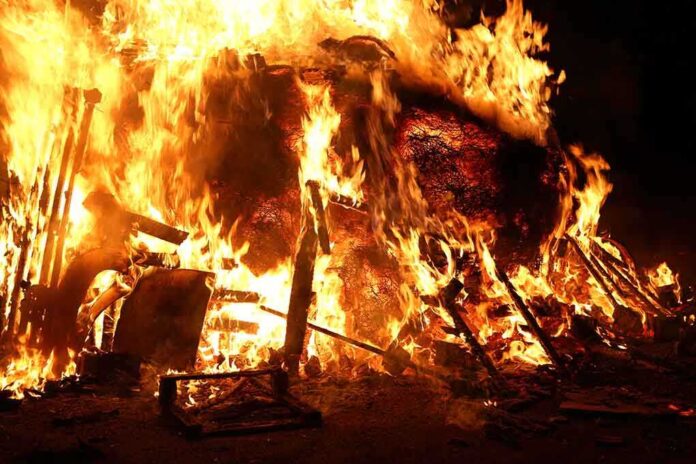
While California’s historic Chinese Camp burned and families fled for safety, the state’s own leadership was reportedly absent—leaving locals questioning who stands with them during crisis.
Story Snapshot
- A lightning-sparked wildfire destroyed historic Chinese Camp, erasing Gold Rush-era homes and heritage in hours.
- Governor Gavin Newsom was reportedly out of state as the disaster unfolded, raising concerns about leadership accountability.
- CalFire battled the fast-moving blaze with limited resources while residents endured urgent evacuations and property loss.
- The event renews debate over government priorities, emergency preparedness, and the vulnerability of America’s history to poorly managed crises.
Wildfire Ravages a Gold Rush Landmark, Leaving Residents Displaced
The 6-5 Fire erupted on September 2, 2025, in Tuolumne County, California, igniting during a lightning storm and rapidly consuming over 6,400 acres. By the evening, the blaze had swept through Chinese Camp, a rural Gold Rush town with deep immigrant roots, destroying at least five homes and forcing urgent evacuations. Residents scrambled to protect their families and property as CalFire coordinated firefighting and evacuations in an uphill battle against the fast-moving flames.
Wildfires Destroy Historic California Town as Newsom Leaves State — Again https://t.co/TWVaTvZhhE
— Marshalr (@humbleprepper) September 3, 2025
Mandatory evacuation orders remained in place through September 3 as the fire continued unchecked, with zero percent containment. Emergency responders requested more resources while families and local businesses braced for further losses. No injuries or deaths were reported, but the destruction of historic buildings has left residents and preservationists grieving the loss of irreplaceable heritage. The fire’s swift devastation was made worse by ongoing drought and high temperatures, conditions that have plagued California’s rural communities for years.
Leadership Questioned as Governor’s Absence Raises Alarm
The disaster unfolded while Governor Gavin Newsom was reportedly out of state on personal travel, sparking widespread concern about leadership during critical emergencies. Although official confirmation of Newsom’s whereabouts is not included in major news outlets, the timing of his absence has renewed frustration among residents already disillusioned by what they see as state government’s misplaced priorities. For many, the lack of visible leadership echoes past grievances about government overreach, fiscal mismanagement, and the neglect of core community needs.
Local agencies and CalFire remained the primary authorities on the ground, directing firefighting and evacuation efforts. However, the strain on state and local resources was apparent, as calls for additional reinforcements went out and residents voiced fears over the potential for even greater loss. This event has reignited debate over how public resources are allocated and the importance of responsive leadership during crises—issues that resonate deeply with Americans who value accountability and limited, effective government.
Historic Losses Underscore the Need for Conservative Solutions
Chinese Camp’s destruction is more than a local tragedy—it is a warning about the fragility of America’s history and the consequences of government inaction. The town, founded by Chinese miners in the 1850s after discriminatory policies forced them out of neighboring camps, stood as a testament to both hardship and resilience. Its loss highlights the vulnerability of historic sites to natural disasters, especially when prevention and preparedness take a back seat to political agendas and bureaucratic waste. For conservatives, the tragedy underscores calls for restoring common-sense priorities: investing in emergency readiness, cutting red tape, and putting local communities—not distant politicians—first.
The broader pattern of devastating wildfires in California, including the 2018 Camp Fire and the 2020 Lightning Complex, demonstrates that these are not isolated incidents but symptoms of deeper issues. As families face displacement, economic hardship, and the erasure of cultural heritage, many are demanding reforms that strengthen local control, improve resource management, and hold leaders accountable to the people they serve. The current crisis in Chinese Camp is a sober reminder that effective government means standing with citizens during their worst moments, not abandoning them to manage on their own.
Wildfires Destroy Historic California Town as Newsom Leaves State — Again https://t.co/LdJGOHV34x via @BreitbartNews
— Pappin (@pappinworld) September 3, 2025
Recovery, Accountability, and the Way Forward
As the 6-5 Fire rages on, the immediate focus remains on containing the blaze, protecting the remaining structures, and supporting displaced families. Yet the long-term implications are clear: without a renewed commitment to responsible governance and constitutional values, more communities may face similar devastation. The destruction of Chinese Camp should drive policymakers to prioritize practical solutions over political theater, ensuring that America’s history and its people are safeguarded against both natural and man-made threats. For conservatives, this event reinforces the importance of vigilance, local empowerment, and unwavering accountability from those entrusted with public leadership.
Sources:
Wildfire Scorches Historic California Gold Mining Town, Burning Homes
Quick-moving wildfire scorches historic California Gold Mining town
Wildfire Scorches Historic California Gold Mining Town, Burning Homes