A second suspected oil slick near Iran’s Kharg Island threatens a vital energy chokepoint and spotlights a regime denial that still lacks hard evidence.
Story Highlights
- Multiple satellites show a large slick west of Iran’s Kharg Island, a critical oil export hub [1][3].
- Independent analysts say the imagery is consistent with oil and spans roughly 45 square kilometers [2].
- Iran denies a spill and blames a foreign tanker but has provided no vessel name or data [5].
- Unverified causation raises security, economic, and environmental risks across the Persian Gulf [4].
Satellite Imagery Points to Significant Slick Near Kharg
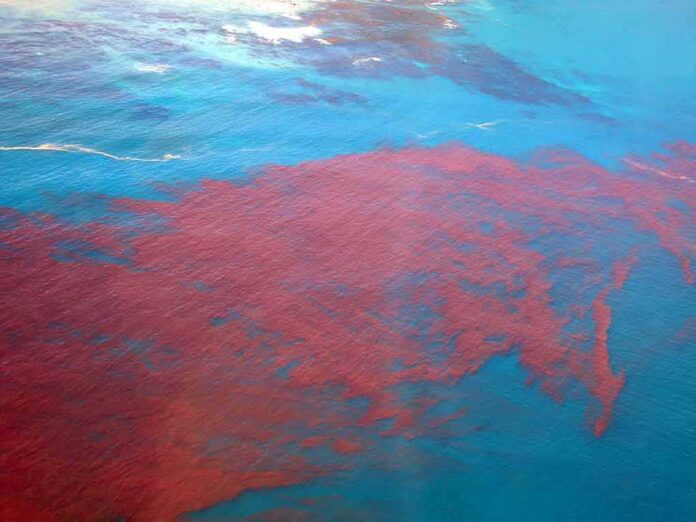
European Union Copernicus Sentinel satellites captured images between May 6 and May 8 showing a broad gray-and-white sheen west of Kharg Island, Iran’s primary oil terminal in the Persian Gulf [1]. News outlets summarizing those images reported a spreading slick near major export pipelines and storage facilities, underscoring both environmental and strategic risk if contamination moves with currents toward regional shores [3]. Analysts reviewing the frames flagged the feature’s shape, contrast, and persistence as signatures consistent with oil, pending on-water confirmation [2].
Independent observers cited by international coverage estimated the surface area around 45 square kilometers, indicating a substantial release if confirmed as petroleum rather than surface film or algal phenomenon [2]. Broadcast segments amplified concerns that the slick’s proximity to a major loading hub complicates rapid source identification and containment, given heavy tanker traffic and sensitive infrastructure concentrated around Kharg [4]. Without verified sampling or operational logs, the imagery remains the strongest public evidence of a petroleum presence over multiple days [1].
Tehran’s Denial Lacks Specific Forensic Rebuttal
Iranian officials rejected reports of a terminal-linked spill and asserted the sheen came from a foreign tanker discharge, characterizing external coverage as psychological warfare against the country [5]. The denial, however, did not include the vessel’s name, Automatic Identification System track, or port-state inspection records that would substantiate a third-party discharge claim [5]. No public release of terminal integrity data, maintenance logs, or pipeline pressures accompanied the rebuttal, leaving satellite visuals uncontested by equal or better technical counter-evidence [5].
Reporters and analysts emphasized that definitive attribution requires chemical fingerprinting and marine sampling to distinguish heavy Iranian crude from marine fuel residues, alongside time-stamped vessel movement data [3]. Absent that, source identification remains uncertain while risk persists for fisheries and coastal habitats downstream of Kharg [4]. The longer authorities delay transparent data releases—such as loading records or verified spill-response bulletins—the more credibility tilts toward the multi-day imagery record already in the public domain [1].
Strategic Stakes for Energy Security and Regional Allies
A confirmed spill of this scale near Kharg Island would raise shipping and insurance costs across the Strait of Hormuz corridor, where millions of barrels move daily through narrow lanes sensitive to weather, conflict, and environmental disruption [3]. Even without confirmed causation, tanker operators may reroute or reduce speed, introducing delays that tend to tighten supply and nudge prices higher amid already volatile markets [4]. Gulf state coastlines, fisheries, and desalination plants could face exposure if the slick drifts or resurfaces after weathering.
Second suspected oil slick detected close to Iran’s Kharg Island, UN warns of catastrophehttps://t.co/JDc6VwJFdH
NEWYou can now listen to Fox News articles! A second suspected oil slick has been detected near Iran’s Kharg Island export hub, according to maritime intelligence… pic.twitter.com/O511TiEKWP
— WhizBuddy (@WhizBuddy) May 10, 2026
For American readers managing inflation and energy bills, transparency and swift remediation matter more than political narratives. The most practical next steps are clear: release verifiable terminal operational logs, publish independent sampling results, and identify any implicated vessel with time-stamped tracking data. Until those basics are on the table, the weight of available evidence remains the satellite record and expert visual assessments indicating a substantial oil presence near one of the world’s most sensitive energy hubs [1][2][3][5].
Sources:
[1] Satellite Images Show Suspected Oil Spill in Iran’s Kharg Island
[2] A 45 km² oil slick appears in satellite images near Kharg Island, an …
[3] Satellite Images Show Oil Slick Off Iran’s Kharg Island: Report – NDTV
[4] Suspected oil spill near Kharg Island, Iran’s main oil hub – ABC News
[5] Iran denies suspected oil spill near country’s Kharg Island export hub