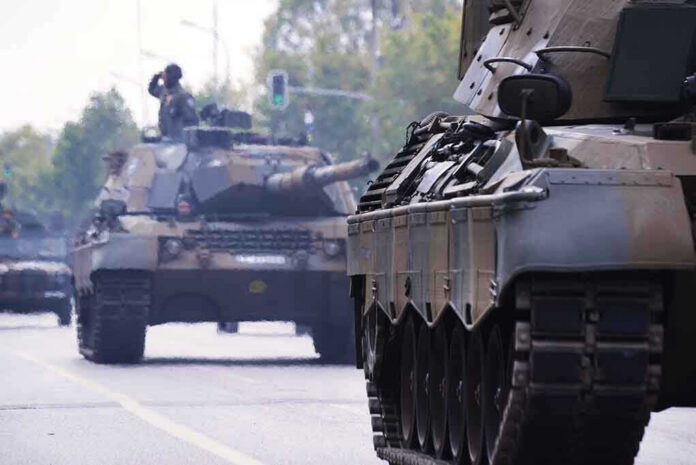
South Korea’s K2 Black Panther tank has become so successful abroad that Poland is getting its 1,000‑tank fleet years before South Korea’s own soldiers see their full orders filled.
Story Snapshot
- Poland locked in up to about 1,000 K2 Black Panther tanks to rebuild its armor fast after Russia’s invasion of Ukraine.
- Warsaw chose South Korea over slow European suppliers, trading “buy European” politics for delivery speed and hard power.[9]
- South Korean factories are now rushing exports so fast that Poland’s needs take priority over South Korea’s own army.[4]
- The deal shows a bigger shift: allies are bypassing old European defense systems and going where industry can actually deliver.[14][18]
Poland’s Tank Shock: Why Warsaw Jumped the Line
Right after Russia’s full-scale invasion of Ukraine, Poland decided it could not wait years for European tank factories to slowly ramp up. Warsaw signed a massive framework deal with South Korea in 2022 for around 1,000 K2 Black Panther tanks, along with artillery and jets, to quickly rebuild its armored forces.[3][9] The first 180 K2s were set to arrive between 2022 and 2025, giving Poland real metal on the ground while some European projects were still in committee rooms.[3]
Reports on the first execution contract say those 180 Korean-built K2s came with training, maintenance support, and ammunition, not just bare hulls.[1] That matters, because a tank that arrives without spare parts or crew training is just an expensive bunker. A follow-on contract in 2025 added 180 more tanks plus over 80 support vehicles, valued at about $6.5 billion, with deliveries scheduled through 2030 and beyond.[5][7] All of this was designed to get combat-ready units fielded fast, not someday.
How the K2 Beat German and Other European Tanks
European makers like Germany had modern tanks on paper, but they were backed up with long delivery queues and limited production capacity. Analysts note that Poland could receive 180 K2s from South Korea starting almost immediately, while similar numbers of new Leopard 2s would have taken far longer because German industry was already overloaded.[3][9] One assessment says the K2 package offered nearly twice the quantity for similar spending, plus support and technology transfer for local production.[1][8]
South Korea’s pitch went beyond price. Warsaw got a clear path to build its own upgraded K2PL variant in Poland, starting in the second half of the decade.[3][8] Under the second tank contract, 116 vehicles stay in the Korean K2GF configuration, while 64 are in the Polish K2PL version, with most of those assembled by Polish industry after the first few are built in Korea.[3][5] That mix lets Poland field tanks now, then shift to domestic production and upgrades later, instead of waiting on slow-moving European consortiums.
Poland as Europe’s New Tank Hub — and What That Signals to America
Several reports describe plans for Poland to become a European hub for K2 production, with a local factory to build hundreds of K2PL tanks and handle maintenance for the region.[6][8] Under these plans, roughly 800 K2PLs would eventually be produced in Poland through technology transfer, starting around 2026, while earlier Korean-built K2s are upgraded to the same standard.[8][9] That would make the K2 the main tank of the Polish Army and place Polish workers, not Brussels bureaucrats, at the center of a new armored industry chain.
This is part of a wider pattern that Americans should watch closely. Studies of European defense spending show that even as budgets hit record highs, about three quarters of procurement cash is flowing outside the European Union, because local industry simply cannot deliver fast enough.[18] A separate analysis from a Washington think tank describes new “speed first” models of buying weapons that bypass slow processes and send money straight to factories that can produce on time.[14] Poland’s K2 deal is a textbook case of that shift.
South Korea’s Export Rush: When Your Best Tank Goes Overseas First
There is a twist: South Korea’s own army is now waiting in line behind export customers. Coverage of the K2 story notes that Warsaw’s orders are so large and urgent that Hyundai Rotem, the tank’s maker, has prioritized deliveries to Poland while stretching out domestic schedules.[4] For Seoul, this brings in foreign cash and political leverage. But it also shows how global demand is pulling advanced weapons toward the front lines in Eastern Europe faster than home forces get them.
For Americans, this raises real questions. When our allies on NATO’s eastern flank feel so exposed that they skip Europe’s flagship tank projects and look all the way to Asia, it is a sign that the old defense order is not working. Washington is still the main security anchor, but Poland’s choice shows a hunger for partners who move quickly, cut red tape, and understand that deterrence means real brigades ready now, not slide decks about future capabilities.
Speed Over Process: A Warning for Western Bureaucracies
Think tanks tracking Central and Eastern Europe say the region’s governments are shifting from slow “industrial policy first” thinking to “field troops first” decisions.[15][17][19] Poland’s move fits that trend. Warsaw bet on a foreign supplier who promised immediate delivery, detailed support packages, and a clear path to local production, instead of waiting for European Union defense schemes that might protect local firms but leave front-line states under-armed. That is the same frustration many conservatives feel with bloated, process-heavy government at home.
There is also a sober lesson on sovereignty. Critics in Europe argue that buying hundreds of Korean tanks makes Poland dependent on an outside supplier for key parts and upgrades.[7][8] Yet the contracts include technology transfer, local assembly, and maintenance hubs meant to pull that dependence back toward Polish soil over time.[6][8] The trade-off is clear: accept some short-term dependence in exchange for fast armor now and a domestic industry later. Warsaw judged that risk acceptable with Russian troops still bombing Ukrainian cities.
Why This Matters to US Conservatives Watching NATO
For American readers, the K2 story is about more than tank models. It shows what happens when threat, not talk, drives policy. Poland saw a shooting war on its border, added up the risk, and chose speed and strength over committee politics and industrial protection. That choice lines up with core conservative instincts: secure the border, arm the good guys now, and demand that government programs deliver real results, not just press releases.
It also sends a message to the broader West. If we let bureaucracy and “green” wish lists hollow out our defense industrial base, allies will go elsewhere for the weapons they need. South Korea seized that opening. The United States still has the capacity to lead, but only if we fix slow procurement at home, rebuild our own factories, and treat national defense as the first job of government, not an afterthought behind globalist projects and climate conferences.
Sources:
[1] Web – South Korea Built a Tank So Good That Poland Bought 1,000 — Now Its …
[3] YouTube – K2 Black Panther in Poland: Delivery Updates, Upgrades & Future …
[4] YouTube – Hyundai Rotem completes delivery of 180 K2 main battle tanks to …
[5] Web – The K2 Black Panther lands in Poland – SPARTANAT.com
[6] YouTube – Will Poland Make the Largest Modern Tank Force? | K2 …
[7] Web – Poland to become European hub for K2 tank production, S. Korean …
[8] Web – Poland completes negotiations to buy South Korean K2 tanks …
[9] Web – Poland buys more K2 tanks – The Defence Blog
[14] Web – Hyundai Rotem seals record $6.5 bn K2 tank deal with Poland
[15] Web – South Korea to Triple Tank Deliveries to Poland: 96 K2s Incoming in …
[17] Web – [PDF] A Growing Opportunity for Multinational Defence and Security
[18] Web – Strategy at the Geopolitical Crossroads: The Imperative for Secure …
© patriotwise.com 2026. All rights reserved.