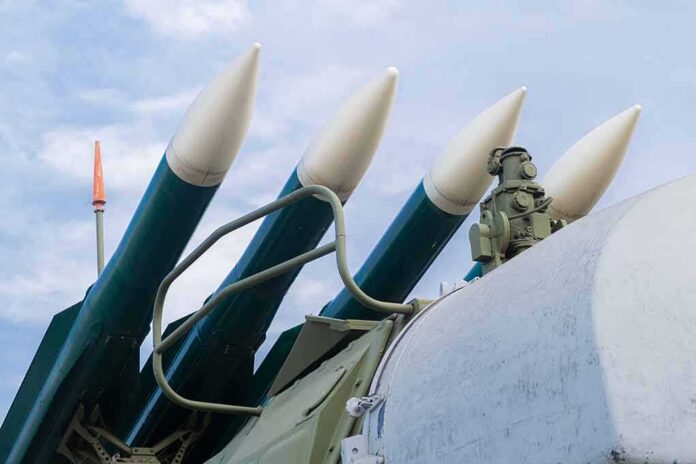
Washington once ejected an ally from the F-35 program over the S-400’s spying risk, while experts still debate whether the system can actually shoot a stealth jet down.
Story Snapshot
- The United States removed Turkey from the F-35 program after it bought Russia’s S-400, citing security risks.
- Analysts agree detection is easier than guiding a missile to a stealth jet’s exact location.
- Some estimates say an S-400 might target an F-35 only at short ranges, if at all.
- No verified combat shows the S-400 defeating an F-22 or F-35 to date.
What Triggered the F-35 and S-400 Standoff
United States officials removed Turkey from the F-35 program in 2019 after Ankara bought Russia’s S-400 air defense system. Defense leaders warned that the S-400 could collect data on the F-35’s stealth features if both systems operated together. They argued this posed a long-term security risk to the jet and to allied networks. Congress later documented Turkey’s removal and the financial fallout tied to lost industrial work on the aircraft.
That decision told allies and rivals the same thing. Washington takes the S-400 seriously as an intelligence platform near fifth-generation jets. Supporters of the S-400 point to its layered radars and long-range missiles, including the 40N6 family. They argue it can track many targets across wide areas and threaten high-value aircraft. Public writeups describe a system that is mobile, networked, and built to stress enemy air forces before they get close.
Inside the Kill Chain: Detecting Is Not the Same as Hitting
Engineers break air defense into steps. A sensor detects, then maintains a track, then builds a precise “weapons-quality” track to guide a missile. The S-400 uses a long-range surveillance radar to find objects and a separate engagement radar to guide shots. Stealth designs aim to make that last step fail by cutting radar returns where it matters. Technical summaries explain that lower-frequency radars may see a stealth jet, but not guide a weapon onto it.
Commentary from a former United States Navy operations specialist makes the same point in plain terms. He says the S-400’s low-frequency radar might notice an F-35 in the area. But it would still need its higher-frequency fire-control radar to lock on for a shot. He estimates a possible lock could occur only at short ranges, depending on conditions. Those numbers are debated, and much data remains classified, but the logic tracks with how these systems work.
What Open Sources Say About Ranges and Real-World Proof
Open-source estimates vary, but several land in a tight band. One public estimate reported by a regional outlet says detection of an approaching F-22 might occur at about 21 kilometers and an F-35 at about 34 kilometers. Another technical summary cites a study that places likely F-35 targeting at around 20 miles. These are modeled figures based on public data, not combat logs, so they should be read with care.
So far, no verified combat engagement shows the S-400 tracking, targeting, and downing an F-22 or F-35. Coverage that compiles what is known stresses that many bold claims rest on brochures and tests, not wartime results. That gap fuels arguments on both sides. Supporters say absence of proof is not proof of absence. Skeptics say the system’s most sweeping claims remain unproven against fifth-generation jets that were built to break that kill chain.
Why This Debate Matters for U.S. Policy and Public Trust
Policy choices carry costs for taxpayers and troops. When the United States barred Turkey from the F-35 program, it accepted disruption to supply chains to protect the jet’s secrets. That reflects a core principle: secure the edge before it is lost. Voters watching defense budgets grow want proof that leaders are guarding hard-won advantages, not gambling them away to please foreign buyers or defense contractors.
For citizens on the right and left, the deeper concern is familiar. Powerful players often sell big claims, while key evidence stays hidden. The S-400 versus stealth fight shows why clear standards matter. Separate what can be shown from what is hyped. Track the full chain: detection, tracking, targeting, guidance, and intercept. Demand that policies match facts, not press releases. That is how a free people keep both their wallet and their security intact.
What to Watch Next
Watch for verified testing and allied exercises that share unclassified results. Look for updates on electronic warfare tactics that blind engagement radars before they can lock on. Follow whether nations try to co-locate S-400-class systems near allied fifth-generation jets again, and how the United States responds. Keep an eye on budget oversight hearings that ask if programs protect secrets and lives. Results, not talking points, should drive the next round of choices.
Sources:
19fortyfive.com, war.gov, congress.gov, reuters.com, globalsecurity.org, en.wikipedia.org, militarymachine.com, theaviationgeekclub.com
© patriotwise.com 2026. All rights reserved.