
President Trump flew to Ankara, Turkey, this week for a NATO summit where allies face a blunt question: are they doing enough to keep America’s protection — or not?
Story Snapshot
- Trump arrived in Ankara for the July 7–8 NATO summit, saying he came mainly out of respect for Turkish President Recep Tayyip Erdoğan.
- The top agenda item is whether allies are hitting the 5% of gross domestic product (GDP) defense spending target agreed at last year’s Hague summit.
- NATO Secretary General Mark Rutte promised “tens of billions” in new defense contracts and called this summit more important than last year’s.
- Trump hinted at a “big gift bag” for Turkey — possibly dozens of F-35 fighter jets — raising questions about what the U.S. gets in return.
Trump Arrives With Leverage — and a Gift Bag
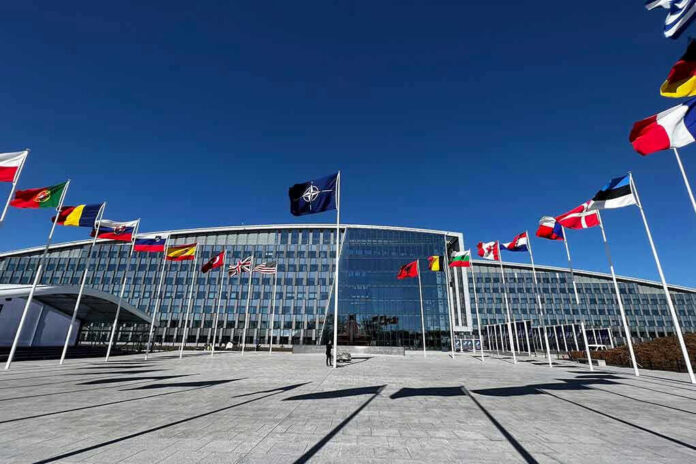
Trump landed in Ankara for the 36th NATO summit, held July 7–8 at Turkey’s Beştepe Presidential Compound. He said flatly that he would not have attended without his personal relationship with President Erdoğan. He also hinted at bringing a major offer to his host — possibly the sale of dozens of F-35 fighter jets to Turkey. No official deal has been confirmed, but the signal was clear: personal relationships and arms deals now shape U.S. diplomacy as much as any treaty.
For years, Turkey was viewed with suspicion by other NATO allies. It bought a Russian air defense system, attacked Western-backed Kurdish forces in Syria, and stalled Sweden’s bid to join the alliance. Now Turkey is hosting the summit and may be in line for top American fighter jets. That shift tells you a lot about how Trump runs foreign policy — through deals and personal bonds, not traditional alliance norms.
Pay Up or Lose U.S. Backing — That’s the Message
Matt Whitaker, the U.S. ambassador to the North Atlantic Treaty Organization (NATO), said the summit will measure how well allies are meeting the 5% of GDP defense spending target. He added that the U.S. will “take stock” of allies expanding NATO’s capabilities. Trump has tied U.S. security commitments to this spending benchmark since his first term — and that pressure has only grown. At last year’s Hague summit, allies agreed to the 5% target under heavy American pressure.
Trump went further this time. He framed allied support for the U.S. conflict with Iran as a test of loyalty — even though NATO’s collective defense agreement only requires members to respond when a member country is attacked. Trump’s demand goes beyond that rule. Whether allies back him on Iran or not, he is using the summit to define what American protection is worth — and what it will cost.
Rutte Promises a “Defense Industrial Revolution”
NATO Secretary General Mark Rutte called the Ankara summit more important than last year’s meeting in The Hague. His reason: this summit is about turning promises into action. Rutte said leaders would announce “tens of billions” of dollars in new defense contracts. He described the moment as the start of a transatlantic “defense industrial revolution” — with investments aimed directly at countering Russia.
"President Trump signaled that he may be open to giving Turkey F-35 fighter jets."
FRC's Mary Stackhouse shares highlights from today's NATO summit.
Guest host: @JodyHiceFRCA pic.twitter.com/xTuhCfJv1q
— Family Research Council (@FRCdc) July 7, 2026
Anti-NATO protests broke out in Istanbul, Ankara, and Izmir in the weeks before the summit. Labor unions and civic groups opposed higher military budgets and NATO’s expansion. That public pushback is a reminder that not everyone — on either side of the Atlantic — sees more military spending as the answer. Many ordinary citizens on both the left and right wonder why billions flow to defense contractors while their own communities struggle with rising costs and shrinking opportunity.
What This Means for Everyday Americans
For Americans already frustrated with government spending and foreign commitments, this summit raises fair questions. The U.S. has long carried a heavier share of NATO’s costs. Trump’s push for allies to spend more is something many Americans across the political spectrum can support. At the same time, tying U.S. military commitments to personal diplomacy and arms deals — rather than clear strategic rules — creates its own risks. When alliances run on favors and gift bags, the rules that protect everyone become harder to count on.
Sources:
youtube.com, abcnews.com, en.wikipedia.org, nato.int, washingtonpost.com, instagram.com, apnews.com, militarytimes.com, reuters.com, cnn.com, thehill.com, facebook.com, politifact.com, nato.usmission.gov, brookings.edu, americanprogress.org, institutdelors.eu, 2017-2021.state.gov
© patriotwise.com 2026. All rights reserved.