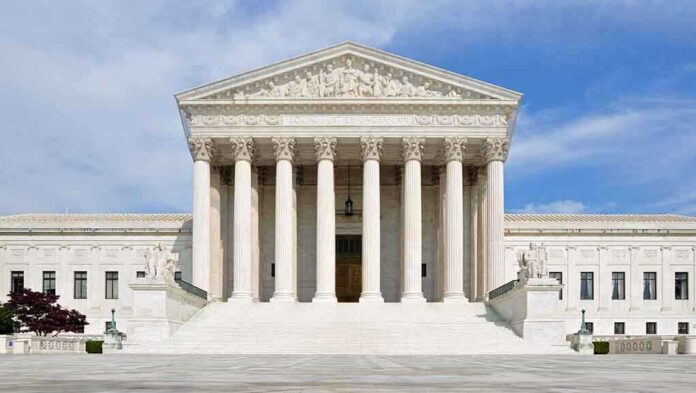
The U.S. Supreme Court just handed women’s sports advocates their biggest legal win ever — ruling 6-3 that states can bar transgender athletes from girls’ and women’s sports without breaking the Constitution or federal law.
Story Highlights
- The Supreme Court upheld state bans on transgender athletes in girls’ sports, ruling they do not violate Title IX or the Constitution’s Equal Protection Clause.
- All nine justices agreed that Title IX allows states to protect women’s sports by using biological sex to set eligibility rules.
- Riley Gaines and Olympic gymnast MyKayla Skinner publicly celebrated the ruling and called out Simone Biles for staying silent on the issue.
- The ruling affects more than two dozen states with similar bans already on the books, but it does not force every state to adopt one.
What the Supreme Court Actually Decided
The Supreme Court ruled in two combined cases — West Virginia v. B.P.J. and Little v. Hecox — that Idaho and West Virginia did not break the law by banning transgender athletes from girls’ sports. Justice Brett Kavanaugh wrote the majority opinion. “May schools determine eligibility for women’s and girls’ sports based on biological sex? The answer is yes,” he wrote. The six conservative justices agreed. The three liberal justices dissented on the equal protection question but agreed on Title IX.
The court’s majority said sports are “generally zero sum” — meaning every roster spot, medal, and scholarship won by one athlete is one another athlete doesn’t get. The justices said states have a valid interest in protecting safety and competitive fairness. Importantly, every single justice — all nine — agreed that Title IX, the federal law banning sex discrimination in schools, allows states to set sports eligibility based on biological sex.
Gaines and Skinner Celebrate — and Call Out Biles
Former collegiate swimmer Riley Gaines and Olympic gymnast MyKayla Skinner both went public with their reactions quickly after the ruling came down. Gaines said she felt “absolutely vindicated.” Skinner, now a mother, said her motivation was simple: she wants her daughter to have equal athletic opportunities. Both women have been outspoken advocates for the “Save Women’s Sports” movement for years and called the ruling a defining legal moment for female athletes across the country.
Gaines also used the moment to call on other prominent female athletes to speak up. She named Caitlin Clark, Sophie Cunningham, and Serena Williams — urging them to “link arms” and publicly support protections for women’s sports. The message to Simone Biles was pointed. Biles had criticized Gaines over transgender athlete comments in 2025, then deleted her posts after backlash. Gaines and Skinner challenged Biles to take a clear public stand now that the court has ruled.
What the Ruling Does — and Doesn’t — Change
More than two dozen Republican-led states already have laws banning transgender athletes from girls’ and women’s school sports. Legal experts say Tuesday’s ruling will almost certainly protect those laws too. The decision grew out of a decade-long wave of state legislation. The number of states with such bans grew from zero in 2017 to at least 27 by early 2026. The Republican Attorneys General Association held a press conference in January 2026 featuring female athletes who backed the Idaho and West Virginia laws ahead of oral arguments.
Riley Gaines and MyKayla Skinner send message to Simone Biles on women's sports debate after SCOTUS rulinghttps://t.co/3NB5ZvRJ7U
— RED Sand🟥 🇺🇲🇮🇱🇬🇧🇩🇪⚓🤿🏴☠️🔱🃏♦️♣️♥️♠️ (@Trumplar) July 1, 2026
Still, the ruling has real limits. It does not force every state or school to adopt a ban. States that currently allow transgender athletes to compete on teams matching their gender identity can keep doing so for now. Transgender rights advocates argue the court is targeting a small number of athletes at great public cost. Lambda Legal attorney Sasha Buchert put it plainly: the ruling says “a state may discriminate, not that it must discriminate.” Legal challenges in other states are likely to follow. The debate over fairness, inclusion, and the science of athletic performance is far from settled — but the legal ground has shifted significantly.
Sources:
thegatewaypundit.com, foxnews.com, abc45.com, aol.com, youtube.com, republicanags.com
© patriotwise.com 2026. All rights reserved.