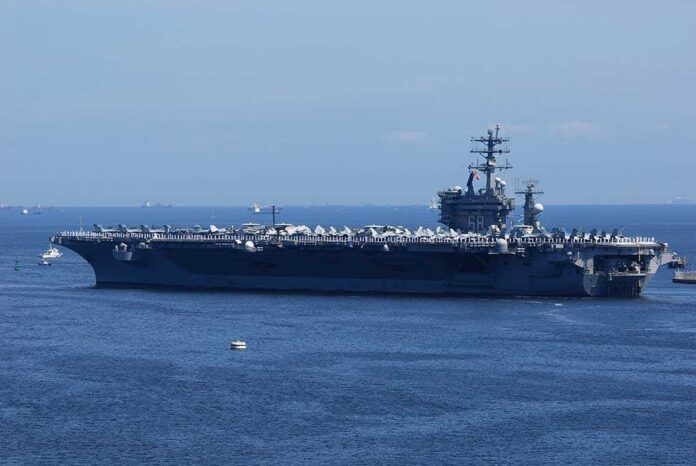
U.S. war games keep showing a disturbing pattern: billion‑dollar supercarriers can be “killed” by much cheaper diesel submarines that slip past their defenses unseen.
Story Snapshot
- Allied diesel-electric submarines have repeatedly “sunk” U.S. carriers in major exercises, exposing real weaknesses in carrier protection.
- Air‑independent propulsion and battery power let modern diesel subs run almost silent, especially in coastal waters where carriers are most at risk.
- The Pentagon has poured money into sensors and networks, but experts say anti‑submarine warfare still relies on probability, not certainty.
- China is building and modernizing a large diesel‑electric fleet, raising hard questions about whether U.S. taxpayers’ $13 billion carriers are truly safe.
How Cheap Submarines Keep Beating Expensive Carriers
Since the 1980s, real exercises have shown quiet diesel submarines slipping through U.S. carrier screens and earning valid “kills.” In a 1981 NATO drill, a Canadian Oberon‑class boat reportedly penetrated defenses and simulated sinking the USS Dwight D. Eisenhower, a ship worth over $5.5 billion. Later war games saw German, Swedish, and Australian diesel subs reach firing positions on carriers like USS Enterprise, USS Ronald Reagan, and their escorts, often without being detected until it was too late.
These submarines succeed because of how they move and hide. When running slowly on batteries, conventional diesel‑electric subs are extremely quiet, giving off only limited mechanical and water‑flow noise. New air‑independent propulsion systems let them stay underwater for weeks at low speed without surfacing to snorkel, which breaks old tracking methods that depend on catching subs when they need air. In cluttered, shallow coastal waters with tricky temperatures and heavy traffic, they can sit and wait while a large, noisy carrier group sails right past them.
Why Anti‑Submarine Warfare Is Never a Sure Thing
U.S. admirals openly call diesel submarines a classic “asymmetric threat” that can block access to coastal combat zones and put carriers at risk. Anti‑submarine warfare is not a shield that always works; it is a game of probabilities. Large networks of sonobuoys, aircraft, surface ships, and nuclear attack submarines search huge areas, but gaps and blind spots remain. Exercises with allied diesel subs have forced the Navy to admit that even top‑tier defenses can be penetrated when the conditions favor the attacker.
To close that gap, the Navy has invested in distributed sensor networks and new shallow‑water systems. Hundreds of floating sensors can be laid from ships or aircraft to listen for subs over wide areas. Unmanned underwater vehicles and advanced hydrophone arrays are meant to detect even very quiet boats near hostile coastlines. These tools improve carrier protection, but even friendly analysts stress that there is no magic solution. A patient, skilled submarine crew using terrain, thermal layers, and background noise can still find ways through.
China’s Growing Diesel Fleet and the Risk to U.S. Power
China is replacing older diesel submarines with modern Kilo, Song, and other classes, building a sizeable conventional fleet alongside its nuclear boats. Many of these newer subs carry advanced torpedoes and benefit from air‑independent propulsion, giving them the same kind of near‑silent battery endurance that has troubled U.S. carrier groups in past exercises. In a future fight close to China’s shores, these subs would operate in their home waters, with short transit paths and many coastal hiding spots, while U.S. carriers push into tight straits and littoral zones.
Think about what this means for ordinary Americans. Taxpayers fund supercarriers that can cost $13 billion or more, plus billions for jets and escorts, yet cheaper foreign submarines keep proving in drills that they can get close enough to sink them. That feels like more than just a technical issue. It looks like a system that favors big, flashy projects and defense contractors over hard questions about vulnerability and value. People on the right and left already feel the “elites” are out of touch; these carrier war games reinforce that worry.
Are Carriers Obsolete—or Just at Higher Risk?
Some think these submarine victories mean carriers are outdated, but the picture is more complex. A major study arguing carriers are still “highly survivable” points out that mines, missiles, and submarines are all serious threats, yet also notes the Navy’s strong undersea warfare tools and new sensors. Diesel subs are most dangerous in chokepoints and coastal zones, not on the open ocean far from land. So carriers are not useless, but they are much less safe near enemy shores than political speeches often suggest.
This debate fits a larger pattern: huge, high‑cost “super weapons” facing smaller, cheaper threats that exploit narrow weaknesses. Critics worry the Pentagon and Congress cling to carriers out of habit, pride, and industry pressure, while rivals like China bet on submarines, missiles, and drones to punch holes in that shield. For citizens who feel both parties ignore real risks, the lesson is clear. War games already show what can happen when quieter, cheaper subs meet massive, expensive carriers. The question is whether leaders will act before a live torpedo, not a fake one, finds its mark.
Sources:
19fortyfive.com, nationaldefensemagazine.org, usni.org, hisutton.com, youtube.com, reddit.com, en.wikipedia.org, nti.org
© patriotwise.com 2026. All rights reserved.