

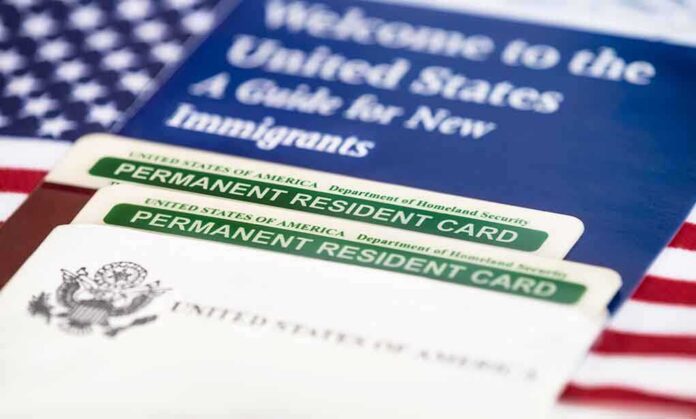
patriotwise.com — A sweeping immigration shift will force most green card hopefuls to leave the United States for consular processing, tightening vetting while risking new delays, costs, and family disruption [4].
Story Highlights
- Most green card applicants will be routed overseas for consular processing, ending in-country adjustments for many cases [4].
- The administration frames the change as anti-fraud and integrity-focused, with expanded rechecks and interviews [4][6].
- Applicant advocates warn of immediate burdens: duplicate medical exams, denials for missing forms, and longer waits [1][3].
- Recent pauses and re-reviews show broader operational slowdowns that could amplify processing uncertainty [3][5].
What The New Departure Requirement Does
Administration-aligned legal summaries report that United States Citizenship and Immigration Services will redirect most green card applications away from in-country adjustment of status and toward overseas consular processing, requiring applicants to depart the United States before final approval [4]. The shift reverses recent accommodations that allowed more applicants to complete steps domestically. The change is presented as a rules-and-procedures realignment to standardize screening and close perceived loopholes exploited by fraud or incomplete vetting in prior processes [4].
Attorney and advocacy explainers describe immediate procedural consequences for those already in the pipeline. Reports say applications without a current, properly filed immigration medical exam can face denial, even for cases submitted under prior guidance, pushing some applicants to repeat exams at added expense [1]. Community guidance sites further note re-interviews and extra reviews in related categories, signaling a wider posture of reassessment that could ripple into timelines for families and employers counting on predictable adjudications [3].
The Stated Integrity Rationale And Its Limits
Policy overviews attribute the rule to an integrity push: expanded background checks, more in-person interviews, and stricter documentary standards designed to ensure benefits go only to qualified applicants [4][6]. That framing is consistent with earlier “enhanced vetting” directives that empowered agencies to deepen screening across visa and benefits programs [14]. However, available materials do not include the final Federal Register text in this record, limiting visibility into enumerated exemptions, measured fraud rates, or the government’s quantified justification for pushing applicants into overseas processing rather than finishing stateside [4][6].
Critics argue the breadth of rerouting and re-vetting reaches many who are already living lawfully in the country without individualized suspicion, turning a targeted integrity tool into a blanket burden. Applicant-facing channels describe freezes and holds on categories of cases, as well as re-reviews of previously approved benefits in adjacent contexts, reinforcing expectations of delay and uncertainty rather than precision targeting of wrongdoing [3][5][9]. Those accounts document disruption, but they stop short of providing case-level proof of wrongful denials traceable solely to the new rule [3][5].
Practical Impacts On Families, Employers, And Timelines
Requiring departure before final approval predictably raises costs: international travel, time off work, child care, attorney updates, and the prospect of duplicate biometrics or medical exams if documents expire during the shift to consular processing [1][6]. Legal-industry briefings describe layered compliance—new interview expectations, medical filing timing rules, and payment formalities—that compound complexity and increase the chance of technical denials for applicants who would have been approvable under prior procedures [4][6]. These are operational realities that impact Main Street businesses and mixed-status families planning around firm dates.
For a constitutionalist audience focused on the rule of law, the core trade-off is clarity versus control. When agencies centralize decisions abroad, applicants lose the transparency and appeal pathways common in domestic adjudications. When processes change midstream, ordinary people shoulder the cost of government retooling. Supporters can welcome stricter screening to stop fraud and protect American jobs, but they should also insist on clear metrics, narrow tailoring, timely adjudications, and respect for due process to prevent government overreach [4][14].
Sources:
[1] YouTube – Trump admin changes requirements for green cards …
[3] Web – Trump Immigration Policy Changes – USAHello
[4] Web – Immigration: Recent Changes and New Regulations | Insights
[5] Web – Trump Administration Abruptly Stopped Processing Green Card …
[6] Web – New Green Card Rules 2026: What Immigrants Should Know Under …
[9] Web – Trump Immigration Policy Green Card Updates in 2025
[14] Web – A Summary of President Trump’s Immigration-Related Executive …
© patriotwise.com 2026. All rights reserved.