

patriotwise.com — A war that once seemed destined to grind Ukraine into exhaustion is being reshaped by cheap robots that are finally letting Kyiv talk about winning, not just surviving.
Story Snapshot
- Russia’s record drone barrages in May met a Ukrainian air defense network that reportedly intercepted most incoming weapons, blunting Moscow’s pressure.[4]
- Ukraine has turned drones into a mass‑produced, networked weapon system that helps level the field against a larger Russian army.[2][4][6]
- Analysts warn that drones alone cannot deliver victory, but they are changing how territory, logistics, and soldiers can move in this war.[5][7][8]
- Mass robotic warfare in Ukraine raises hard questions for Americans about future conflicts, transparency, and who really controls these technologies.[1][5][6]
Record Russian Drone Barrages And Ukraine’s Air Defense Response
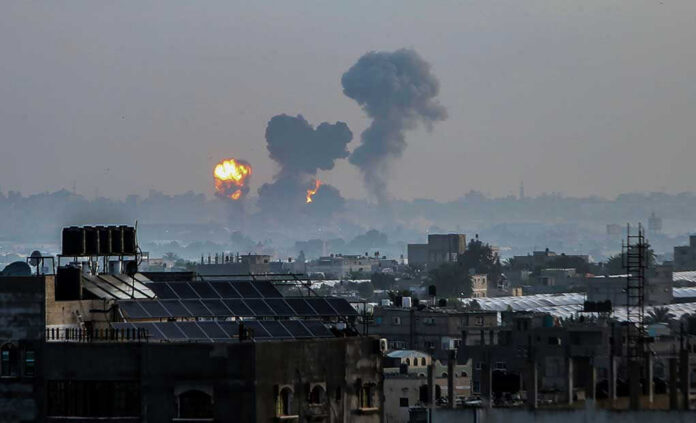
According to an analysis based on Ukrainian Air Force daily reports, Russia launched about 8,150 long-range drones against Ukraine in May, roughly 24 percent more than the previous month and described as a new record.[4] These barrages reportedly included nights when hundreds of drones and missiles were launched in a single wave. Ukrainian officials claimed they intercepted roughly nine out of ten incoming drones and missiles overall, suggesting a highly adaptive air defense network built from Western systems and domestic innovations.[4]
Independent monitoring supports the idea that Russia has shifted heavily into mass drone use, especially so‑called kamikaze drones that crash into targets.[1][7] Research from the United States Military Academy’s Combating Terrorism Center, highlighted in a Statista summary, finds that Russia’s Shahed‑type drone attacks averaged under 1,000 per month in 2024 but have more than tripled to about 3,500 per month from January to May 2025.[1] That pattern of escalation fits with the May 2026 “record” claims, even if exact numbers and interception rates remain contested in wartime.
How Ukrainian “Robot Networks” Are Changing The Battlefield
Ukrainian forces have built dense “drone networks” that tie together military unmanned systems, commercial quadcopters, and civilian communications apps into a single battlefield web.[4] These networks allow Ukrainian units to find Russian troops, direct artillery, drop munitions from the air, and rapidly assess damage, often in real time.[4][7] Allied advisers have trained Ukrainian operators to integrate drones into almost every mission, greatly improving detection and interdiction of Russian movements across trenches, roads, and supply routes.[4]
On the industrial side, Ukraine has pushed drone production to levels that would have been unthinkable before the invasion. European researchers note that Kyiv’s original plan to build one million drones in early 2024 was quickly raised to two million, and later statements from Ukrainian leaders claimed capacity to manufacture up to four million drones per year.[2][6] Western analyses describe this as an “industrial mobilization” around unmanned systems, signaling that low‑cost robots are now central to Ukraine’s strategy rather than a niche tool.[2][6] This mass production underpins both frontline reconnaissance drones and long‑range strike systems aimed at Russian infrastructure.[2][6]
From Survival To Attrition: What Drones Can And Cannot Do
Military scholars caution that even this drone saturation has not produced a clean breakthrough; instead, it has made the battlefield more static and punishing.[5][7][8] Studies from West Point and other institutions argue that drones function less like magic bullets and more like land mines or machine guns in earlier wars: they deny movement, expose any concentration of troops, and punish mistakes, but they do not by themselves seize and hold ground.[5][7][8] Both armies now risk rapid losses if they attempt large maneuvers under constant drone surveillance and attack.[5]
Russia fired 729 missiles and drones at Ukraine overnight on 2 June, killing 10 across Kyiv and Dnipro
Air defenses intercepted 642 weapons. Rescuers are searching for residents trapped after a 9-story Kyiv apartment block partially collapsed in a "double tap" strike.… pic.twitter.com/ewGy1miFIc
— Euromaidan Press (@EuromaidanPress) June 2, 2026
Analysts point out that this reality creates a kind of robotic stalemate where technology delays defeat but does not guarantee victory.[5][7] Ukraine’s improved interception rates and offensive drone strikes may prevent Russia from achieving its objectives quickly, yet decisive gains still depend on combined arms operations, manpower, and sustained logistics.[5][7][8] That context helps explain why Kyiv talks about “winning the drone war” while still fighting for relatively small territorial changes on the ground and continuing to demand Western ammunition, air defenses, and financial support.[3][5][6]
Why This Matters For Americans Distrustful Of The “War Machine”
The drone war over Ukraine speaks directly to American fears that technology is making conflict easier to start and harder to control, often with limited public oversight. Researchers emphasize that both Russia and Ukraine release selective statistics on interceptions and losses, while outside observers struggle to verify monthly “record” claims without full access to raw data.[1] This information gap feeds skepticism that governments and defense contractors may be shaping narratives to justify massive spending on new weapons systems.
For citizens across the political spectrum who already distrust Washington’s foreign policy establishment, Ukraine’s robot-heavy battlefield is a warning and a lesson. On one hand, relatively cheap drones have helped a smaller country resist a larger aggressor, showing how innovation can check raw power.[2][3][4] On the other hand, experts note that flooding future wars with millions of unmanned systems could lock societies into grinding attrition while elites, think tanks, and defense companies debate “lessons learned” from a safe distance.[5][6][7] The Ukrainian experience suggests that robots can help a nation survive—and sometimes even talk about winning—but they do not replace the need for honest strategy, clear objectives, and accountable leadership.
Sources:
[1] Web – Russia fired record 8,150 drones at Ukraine in May: AFP analysis
[2] Web – Russian Offensive Campaign Assessment, May 26, 2026 | ISW
[3] YouTube – BOROVA HAS FALLEN 294 Russian Drones + Ukraine …
[4] YouTube – Ukraine Is Winning the Drone War – Russia’s 2026 Offensive Is Failing
[5] Web – Ukraine: Russia launched a record number of drones in May
[6] Web – Russian Offensive Campaign Assessment, May 29, 2026
[7] Web – Ukraine May Experience a Breakthrough Amidst War with Russia …
[8] Web – Witold Stupnicki on Russia’s largest drone attack on Ukraine – ACLED
© patriotwise.com 2026. All rights reserved.