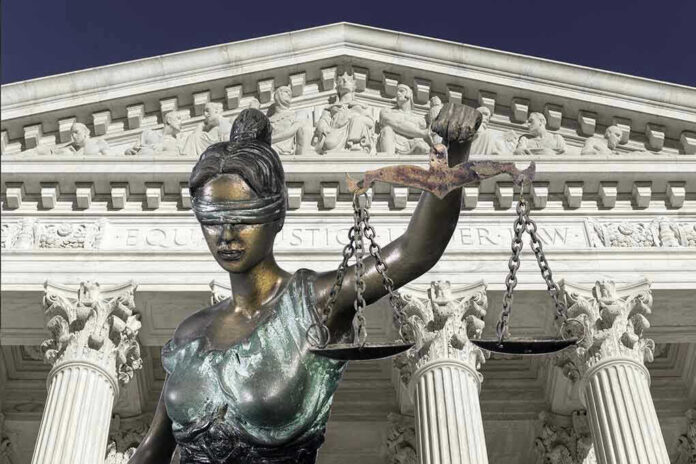
With the Supreme Court now questioning the limits of presidential power on tariffs, the future of America’s economic sovereignty and constitutional checks and balances hangs in the balance—leaving conservatives watching Chief Justice Roberts for a decision that could redefine executive authority.
Story Snapshot
- The Supreme Court, led by Chief Justice Roberts, is reviewing whether Trump’s use of national security tariffs overstepped constitutional limits.
- The ruling could either reaffirm or limit future presidents’ ability to impose tariffs without congressional oversight.
- Trump’s aggressive tariff policies generated record federal revenue and were central to his America First economic strategy.
- The case highlights ongoing battles over executive power, congressional authority, and the defense of American manufacturing and jobs.
Supreme Court Scrutinizes Presidential Tariff Powers
On November 5, 2025, the U.S. Supreme Court, under Chief Justice John Roberts, heard arguments in Learning Resources v. Trump—a case directly challenging whether the president can unilaterally enact sweeping tariffs using Section 232 of the Trade Expansion Act of 1962. This section, invoked by Trump to protect American industries like steel and aluminum, has rarely been tested at this level. Roberts and several justices expressed skepticism about the breadth of authority claimed, questioning both the unprecedented scale of the tariffs and the lack of explicit congressional direction. The outcome will set a precedent for how much power future presidents have over trade without legislative checks.
For conservatives, this case is a bellwether for defending constitutional separation of powers. Trump’s America First approach—using tariffs as leverage—shifted trade policy toward prioritizing U.S. manufacturing and blue-collar jobs. Critics argue unchecked executive power could erode congressional authority and invite overreach, while supporters warn that restricting presidential flexibility would tie America’s hands in defending its own economy. As the justices deliberate, the question is whether the Court will protect the constitutional balance or open the door to further executive action without meaningful oversight.
Tariffs, Revenue, and Economic Nationalism
President Trump’s tariffs on steel, aluminum, and other imports from 2018 to 2020 marked a dramatic pivot from decades of globalist trade policy. These actions generated nearly $90 billion in tariff duties for the U.S. Treasury in 2025 alone, with the federal government posting a record $27.2 billion surplus in June—the first in two decades. Trump’s strong stance forced foreign companies and governments to renegotiate and brought trillions in investment pledges to American soil. These results, hailed as victories by conservatives, stand in stark contrast to the previous administration’s globalist, open-border approach that saw manufacturing jobs shipped overseas and American workers left behind.
Despite these successes, legal challenges mounted, with business groups and some lawmakers concerned about the president’s ability to impose tariffs without congressional approval. The courts delivered conflicting rulings, escalating the issue to the Supreme Court. The outcome now rests with Roberts and the justices, who must decide whether to uphold the president’s power to defend the nation’s economic interests, or to require more explicit direction from Congress—potentially hamstringing any future efforts to protect American jobs from unfair foreign competition.
What’s at Stake: American Jobs, Congress, and the Constitution
The stakes for American families and businesses are immense. If the Court limits presidential authority, Congress will need to step up and reclaim its constitutional role in trade policy—something many conservatives have demanded for years. For too long, executive agencies have expanded their reach, often at the expense of individual liberty and common-sense governance. Trump’s approach, while aggressive, was a direct response to decades of job loss, unfair trade practices, and economic stagnation fueled by globalist priorities. Steel, aluminum, and broader manufacturing sectors are watching closely, as are international partners and American consumers facing shifting prices.
Short-term, the uncertainty has real consequences for businesses and workers. Long-term, the ruling could either lock in a powerful tool for defending American industry or signal that even the president must answer to Congress in matters of national economic security. Either outcome will shape the balance of power in Washington for years to come and determine whether the government protects American workers or surrenders to global pressures.
Expert Perspectives Reflect Deep Division
Legal scholars and business leaders are sharply divided. Some warn that unchecked executive authority undermines the very constitutional framework that protects American liberty. Others insist that the president must have the flexibility to respond rapidly to economic threats—especially in a world where hostile powers exploit trade for strategic gain. The Court’s decision will echo far beyond trade policy, affecting future debates on government overreach, constitutional rights, and the defense of American interests. As Roberts weighs his options, conservatives await a verdict that could either safeguard the principles of limited government or reinforce the need for vigilance against creeping executive power.
With the Supreme Court’s decision likely to arrive in 2026, every American who cares about constitutional checks and balances, economic freedom, and the future of American industry should pay close attention. Will Roberts and the Court defend the separation of powers, or will they grant the executive unchecked authority? The answer will say much about the direction of the nation under renewed conservative leadership—and whether the lessons of past globalist missteps have truly been learned.
Sources:
POLITICO, November 5, 2025: Supreme Court oral arguments coverage
Supreme Court of the United States, Oral Argument Transcript, Case 24-1287