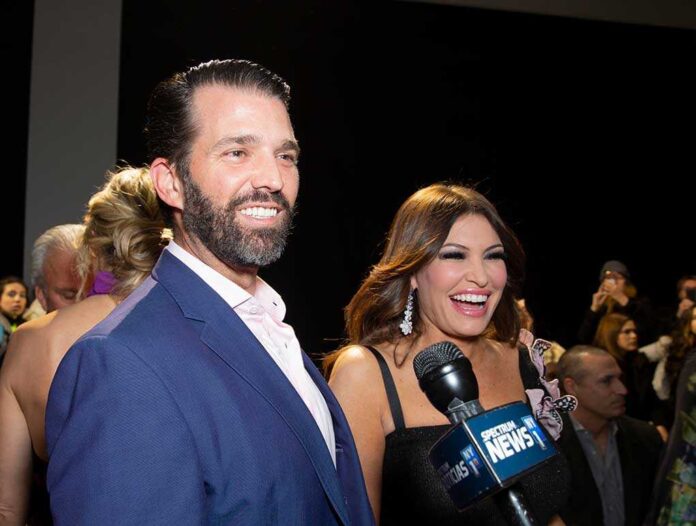
Donald Trump Jr. has quietly become the most powerful person in Washington without holding a single government position, wielding unprecedented influence over cabinet appointments and reshaping the Republican Party from inside the Trump administration.
Story Snapshot
- Trump Jr. orchestrated J.D. Vance’s selection as Vice President, claiming he “exerted 10,000% of my political capital” to secure the Ohio Senator’s spot on the ticket
- Operating as honorary chair of the presidential transition team, Trump Jr. has influenced major cabinet appointments including Robert F. Kennedy Jr. and Tulsi Gabbard, prioritizing ideological “disrupters” over establishment figures
- His emerging kingmaker role signals a potential shift in Republican Party power dynamics, with family-based authority now superseding traditional party structures and institutional hierarchies
- The ongoing Senate seat succession in Ohio will test the limits of Trump Jr.’s influence within the broader Republican establishment as Governor DeWine weighs multiple candidates
From Family Business to Political Kingmaker
Donald Trump Jr.’s rise to political prominence began long before his father’s 2024 election victory. His early appearances on “The Apprentice” established him as a recognizable public figure, but his real political education came during his father’s 2015 presidential campaign. While skeptics questioned Trump’s viability, Trump Jr. leveraged his personal connections and credibility with conservative voters—particularly hunters, Second Amendment advocates, and business-minded Republicans—to build grassroots support. This early success demonstrated a critical insight: Trump Jr. could reach constituencies his father struggled to connect with authentically.
The Vance Endorsement That Changed Everything
Trump Jr.’s influence truly crystallized during the 2022 Ohio Senate race. While J.D. Vance was seeking his party’s nomination, Trump Jr. became an early and vocal backer, actively nudging his father toward endorsement. This proved consequential because Trump initially harbored serious doubts about Vance’s electoral viability, particularly given Vance’s prior public criticisms of Trump himself. Trump Jr.’s persistent advocacy bridged this gap, helping his father overcome reservations and ultimately delivering the endorsement that secured Vance’s path to the Senate. This success established Trump Jr. as more than just a family member—he demonstrated he could move the needle on major political decisions.
Election Night Victory and Transition Team Control
Following Trump’s 2024 general election victory, Trump Jr. was positioned as honorary chair of the presidential transition team, a role that placed him at the center of personnel decisions shaping the entire administration. In a Tucker Carlson interview on election night, Trump Jr. revealed the intensity of his advocacy for Vance, stating: “I exerted 10,000% of my political capital. I may get a favor from my father in like, 2076. I used it all.” This candid acknowledgment underscored both his commitment to the Vance selection and his awareness that he had spent considerable political capital achieving it. Yet rather than diminishing his influence, this expenditure seemed to solidify his position as his father’s most trusted advisor on administration staffing.
Cabinet Appointments and the “Disrupter” Strategy
Trump Jr.’s influence extended far beyond the vice presidency. His fingerprints appeared on major cabinet appointments, most notably Robert F. Kennedy Jr. as Director of Health and Human Services and Tulsi Gabbard as Director of National Intelligence. Both selections represented departures from traditional Republican establishment picks, signaling Trump Jr.’s preference for ideological alignment and disruptive potential over institutional experience. When questioned about these unconventional choices, Trump Jr. defended them explicitly: “They are going to be actual disrupters. That’s what the American people want.” This statement revealed his governing philosophy—prioritizing ideological purity and anti-establishment credentials over bureaucratic competence.
The Ohio Senate Seat: A Test of Influence
J.D. Vance’s elevation to Vice President created a vacant Ohio Senate seat, triggering a succession process that will reveal the true extent of Trump Jr.’s political power. Ohio Governor Mike DeWine holds appointment authority, and multiple candidates have expressed interest, including entrepreneur Vivek Ramaswamy, Lieutenant Governor Jon Husted, Attorney General Dave Yost, and Congressman Dave Joyce. DeWine indicated the appointment decision could come before year’s end, creating immediate pressure from competing factions. Trump Jr.’s preference for candidates aligned with the MAGA movement’s disruptive vision—particularly Ramaswamy—contrasts with DeWine’s more moderate political instincts, setting up a potential conflict that will test whether Trump Jr.’s influence extends beyond his father to other Republican leaders.
Business Interests and Political Power: A Dangerous Blend
What distinguishes Trump Jr. from traditional political operatives is his simultaneous roles across business, politics, and media. He serves as executive vice president of the Trump Organization, co-founder of Winning Team Publishing with close ally Sergio Gor, active venture capitalist, and crypto entrepreneur. This hybrid positioning creates unprecedented opportunities for influence but also raises serious questions about conflicts of interest. When the same person wielding influence over federal appointments also controls business ventures seeking favorable regulatory treatment or government contracts, traditional accountability mechanisms break down. The normalization of this arrangement could establish dangerous precedent for future administrations, blurring critical boundaries between private enterprise and public service.
Reshaping Republican Party Power Dynamics
Trump Jr.’s emergence as a kingmaker signals fundamental restructuring of Republican Party power. Historically, party power flowed through institutional channels—the Republican National Committee, congressional leadership, major donors, and ideological organizations like the Club for Growth. Trump Jr.’s influence operates outside these traditional structures, flowing instead through family relationships and personal networks. His particular appeal to younger, more aggressive conservatives suggests he’s not just exercising current power but potentially positioning himself as heir to the MAGA movement’s leadership. Political strategists note that Trump Jr.’s aggressive communication style resonates particularly with younger men, indicating his influence may grow as generational power shifts within the party.
The Precedent Problem
Perhaps most concerning is the precedent Trump Jr.’s influence establishes for future administrations. If family members wielding substantial executive power without formal position or accountability becomes normalized, it fundamentally alters how American government functions. The Constitution envisions separation of powers, institutional checks and balances, and formal accountability structures. Trump Jr.’s informal co-presidency—where major decisions flow through family relationships rather than institutional processes—circumvents these safeguards. Whether future presidents attempt to replicate this model remains uncertain, but the normalization of family-based executive power represents a significant departure from constitutional governance principles that conservatives have traditionally championed.
Sources:
Politico: Donald Trump, JD Vance Relationship
NPR/CapRadio: JD Vance Vice Presidential Selection
WTTW News: Donald Trump Jr. Emerges as Political Force
News5 Cleveland: The Race to Replace JD Vance in the U.S. Senate