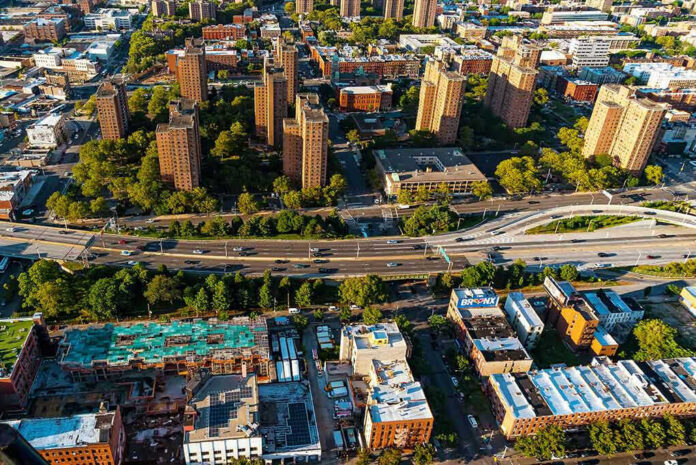
A new South Bronx report says Manhattan’s congestion tolls cleaned the rich core while shunting dirtier air to working-class neighbors — exactly the kind of top-down scheme conservatives warned would happen.
Story Highlights
- Community-Columbia study reports statistically significant PM2.5 increases in the South Bronx after congestion pricing began [1][3]
- Four highway-adjacent monitors saw jumps up to 1.29 micrograms per cubic meter, heightening health risks [1][2]
- Transit agency counters with claims of lower traffic and citywide gains but offers limited post-policy detail [3]
- Study is not yet peer-reviewed and shows mixed results across 19 sensors, leaving room for scrutiny [1][3]
Local Monitors Flag Pollution Rise Near Highways After Toll Launch
Researchers with South Bronx Unite and Columbia University analyzed 19 community-managed air monitors and found a statistically significant average increase of 0.22 micrograms per cubic meter in hourly fine particulate matter from January 2024 through December 2025, covering the period after New York City’s congestion pricing began in early 2025 [1][3]. Thirteen of the 19 sensors recorded increases, with the steepest spikes near major expressways and bridge approaches that funnel traffic around the toll zone [1][2].
Four monitors closest to highway intersections posted statistically significant increases as high as 1.29 micrograms per cubic meter, including a device positioned between the Third Avenue Bridge and the Major Deegan Expressway in Mott Haven, a corridor already burdened by truck and commuter flows [1][2]. Analysts said they controlled for weather, hourly and seasonal patterns, and traffic timing to isolate the post-policy signal, attempting to address common objections about confounding variables [3].
Methods, Limits, and What the Data Can — and Cannot — Prove
The team’s approach used continuous hourly readings and compared pre-policy 2024 data with 2025 outcomes, then applied controls for seasonal and meteorological differences to reduce noise in the comparison [3]. The authors stressed that while the increases were statistically significant, two monitors showed significant decreases, and not every site worsened, underscoring localized effects rather than a uniform borough-wide collapse in air quality [1]. The study has not yet undergone peer review, which limits independent validation of calibration and statistical choices [3].
Because the findings are observational, the authors did not claim a definitive causal chain from the toll to pollution increases, even as the timing aligns with rerouting logic that drivers evade fees by diverting to perimeter highways and bridges [3]. Absent comprehensive, publicly released 2025 traffic counts by corridor and hour for routes like the Cross Bronx Expressway, Major Deegan Expressway, and Third Avenue Bridge, assigning causality remains difficult. The monitors, however, flag where health stakes are highest: highway-adjacent blocks where residents already face high asthma rates [2][3].
MTA and Health Officials Cite Citywide Gains, Defend the Program
The Metropolitan Transportation Authority responded that traffic on the Cross Bronx and Major Deegan decreased last spring by more than ten thousand vehicles daily and that citywide air quality improved, claims that challenge the rerouting hypothesis but were not accompanied by granular corridor-level datasets addressing each affected South Bronx segment in 2025 versus 2024 [3]. Officials labeled the community study preliminary and pointed to a planned summer evaluation that could reconcile conflicting narratives [3].
Transit leaders also highlighted earlier environmental assessments that anticipated slight traffic upticks outside the zone and budgeted roughly seventy million dollars for mitigation projects, including park improvements, vegetation buffers, school air filters, cleaner trucks for Hunts Point, and an asthma center, positioning these steps as safeguards rather than admissions of harm [3]. Advocates counter that mitigation cannot substitute for transparent, audited data on where pollution rose and by how much, especially along truck-heavy bypass routes [2][3].
Manhattan Improvement Versus Bronx Burden: The Policy Trade-off Question
Reports cited by the agency indicate particulate matter fell inside the Manhattan pricing zone, with one academic summary pointing to a double-digit decrease that is now touted as a success story for congestion pricing’s core beneficiaries [3]. The contrast between cleaner air downtown and hotspot increases uptown raises the central question: did a revenue-generating toll shift environmental costs onto lower-income, largely minority neighborhoods outside the zone while elites enjoyed cleaner streets [3]?
South Bronx air quality worsened after NYC congestion pricing toll launched: report https://t.co/Fd99AbwQsH pic.twitter.com/F8UHobpAWR
— New York Post (@nypost) May 9, 2026
Conservative readers have seen this pattern before: top-down social engineering that declares victory downtown while outer-borough families breathe the consequences. The path forward is straightforward and practical. First, require immediate public release of 2025 corridor-level traffic counts and independent calibration audits of all monitors to verify readings [3]. Second, condition any continued tolling on proof that periphery neighborhoods are not paying with their lungs; if mitigation cannot neutralize off-zone harms, suspend or redesign the program.
Sources:
[1] Congestion Pricing in the South Bronx
[2] South Bronx Unite study finds rising pollution from congestion tolls …
[3] South Bronx air quality worsens during first year of congestion pricing