
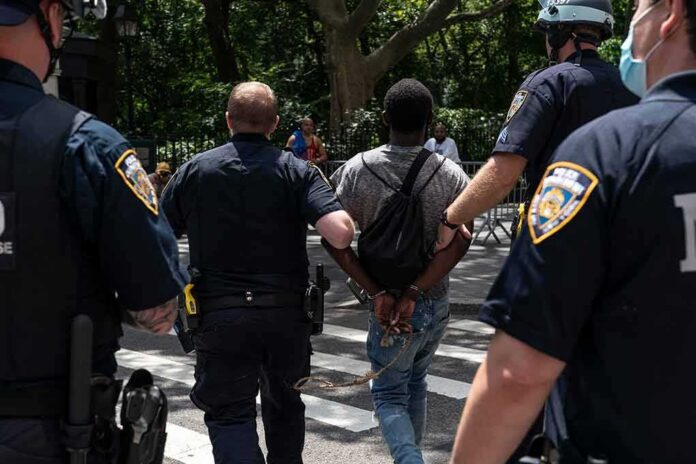
Video from outside President Trump’s Ohio rally showed a man with a knife stuck in his lower back as police moved in.
Story Snapshot
- Video showed a man with a knife protruding from his lower back outside the rally.
- The incident happened in Chillicothe while President Trump addressed supporters.
- Police responded quickly and detained one person at the scene, witnesses said.
- Officials had not released the victim’s identity, condition, or a motive as of late Oct. 28.
What Happened Outside the Chillicothe Rally
Local outlets reported that the incident took place on October 28, 2026, near the Shoemaker Center in Chillicothe. President Trump was speaking inside when people nearby saw a man with a small knife lodged in his lower back. Video shared by a local journalist captured the aftermath. The clip showed the apparent victim upright with the knife visible. Bystanders shouted for help as officers approached the area to secure it and assess the person’s injuries.
Reporters said police rushed to the scene and detained one individual while they sorted out what happened. The local report did not list a suspect name, charges, or a stated motive. Witnesses described a tense few minutes as the crowd realized someone was hurt and officers formed a perimeter. As of late evening on October 28, officials had not issued a formal statement, and major details about identities and medical updates remained undisclosed.
What We Know—and Do Not Know—Right Now
Published accounts agree on several facts. A visible knife injury occurred near the rally venue. The timing lined up with President Trump’s remarks. Police responded and detained one person. However, the reports did not name the injured man or confirm his condition. They also did not identify a suspect or give a reason for the attack. The available video showed only the moments after the injury. It did not capture the exact act or explain how the knife entered the man’s back.
Some outlets described the wounded person as a Trump supporter. That detail has not been confirmed by officials in the reporting reviewed. Without a police narrative or court filing, the public does not yet know whether the event was politically driven, personal, accidental, or something else. Until law enforcement releases records, the strongest confirmed points remain the visible injury, the place and time, and the immediate police response, as seen in video and local accounts.
Why This Matters Beyond One Rally
Americans across the spectrum worry that politics has grown too angry and too risky. Families fear that showing up at rallies, town halls, or protests can lead to harm. Research on demonstrations finds that a small share turn violent, but those events cause outsized damage and stress. One study of events from early 2020 to mid-2021 found that armed demonstrations were violent or destructive more often than events without weapons, highlighting how weapons raise the risks for everyone nearby.
Chillicothe now joins a list of rally-related incidents that fuel those fears. People on the right see scenes like this as proof that public order is slipping and that leaders are not protecting them. People on the left see it as more evidence that our politics rewards outrage over solutions. Both sides share a deeper frustration: a belief that the system talks a big game but fails to keep basic promises, like safe civic spaces. That frustration grows each time violence shadows a political event.
The Public Interest: Facts First, Fast
Clear facts can lower the temperature. Police can help by quickly sharing basic, non-sensitive details: the nature of the injury, whether someone was arrested, and what charges—if any—are being considered. Those steps do not take sides. They help neighbors sort truth from rumor and keep communities calm. When officials wait too long, gaps fill with claims that spread faster than corrections, and fear hardens into distrust of government at every level.
Next steps are straightforward. Authorities can release an incident number, a short summary of events, and a status update on the detained individual. If charges exist, a basic filing will show what police think happened. If not, a simple note can say why. Medical privacy laws limit details, but a general condition update helps. These actions respect the victim, inform the public, and show that leaders take safety—and transparency—seriously.
Sources:
thegatewaypundit.com, sciotovalleyguardian.com, hindustantimes.com, ms.now
© patriotwise.com 2026. All rights reserved.