
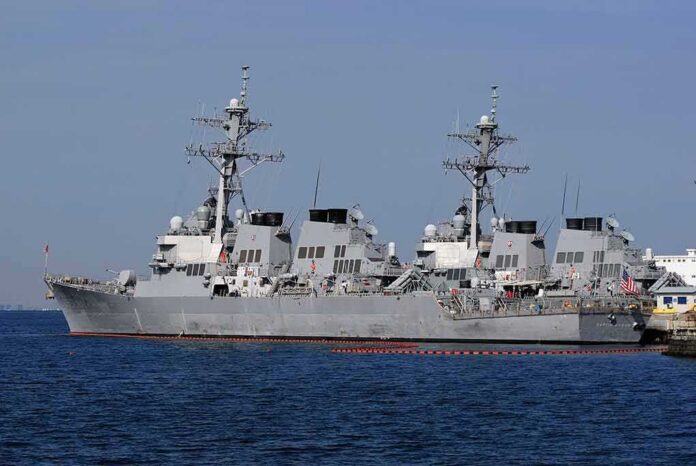
Iran is telling its Gulf neighbors to kick out American troops or face more attacks, and the pressure campaign is happening while a fragile U.S.-Iran ceasefire hangs in the balance.
Quick Take
- Iranian officials are mixing diplomacy and threats to push Gulf states toward a new “regional security” deal that would shrink the U.S. military footprint.
- A senior Iranian figure said Tehran would only end hostilities if the U.S. pays compensation and pulls troops from the Persian Gulf.
- Iran has hit Gulf oil and gas infrastructure to pressure host nations into leaning on Washington to stand down.
- Gulf states are caught in the middle, wanting U.S. protection from Iran but fearing retaliation for hosting American bases.
- No public evidence yet shows Gulf nations have changed basing policy or that a U.S. withdrawal is underway.
Iran Pushes A New Regional Security Deal
Iranian officials are using both talks and threats to press Gulf governments into backing a “regional security mechanism,” according to a June 30 special report from the Institute for the Study of War. Analysts say the plan likely serves Iran’s long-standing goal: getting the United States out of the Middle East for good.
Direct Demands For U.S. Withdrawal
Mohsen Rezai, a member of Iran’s top advisory body, said Tehran would only consider ending the war if the U.S. paid compensation and withdrew its forces from the Persian Gulf. That demand puts American troop presence at the center of any ceasefire talks, not just as a side issue but as a core condition.
Other reporting describes even sharper language. One account says Iran wants Gulf monarchies like Qatar, the United Arab Emirates, Bahrain, Kuwait, and Saudi Arabia to close U.S. bases and block American use of their airspace and airports entirely, or face further attacks.
Gulf States Squeezed From Both Sides
Gulf nations face a hard choice. They want the U.S. military to shield them from Iranian missiles and drones, but hosting American troops makes them targets. Iran has already struck Gulf oil and gas infrastructure to push these governments toward pressuring Washington and Israel to halt military action.
A Carnegie Endowment analysis says Tehran appears to be running a deliberate strategy to wear down its neighbors, using economic and political pressure, plus confusion, to force them to demand the U.S. end the war. At the same time, some Gulf officials have told the U.S. that a ceasefire alone will not be enough. They want Iran’s missile, drone, and proxy capabilities curbed first.
Iran Condemns Joint U.S.-Gulf Statement
Iran’s Foreign Ministry blasted a joint U.S.-Gulf Cooperation Council statement as “interventionist, irresponsible and provocative.” Tehran accused Washington and its Gulf allies of using diplomacy to squeeze Iran after the recent war with the United States and Israel. That accusation shows Iran framing itself as the target of coordinated pressure, even as it applies pressure of its own.
It does make one wonder, are Trump public threats against Iran are aimed at pressuring Iran or actually to pressure the Gulf states to give him more for not escalating the situation?
Because it’s very clear Iran doesn’t care anymore about his public threats
— Nadav Pollak (@NadavPollak) August 2, 2026
What The Evidence Does Not Show
The claim that China is strategically aligned with Iran’s pressure campaign, hoping to keep U.S. forces tied down in the Middle East, lacks direct backing. No Chinese government statement or policy document in the public record confirms that view. The strongest evidence for Iran’s own campaign relies on analyst interpretation of Iranian statements and actions, not a leaked directive or internal order spelling out a coordinated plan.
There is also no sign yet that any Gulf government has actually changed its basing policy because of Iranian pressure, or that the United States has started pulling troops out. What the record does show is a real and escalating standoff. Iran is applying pressure through words and strikes. Gulf states are stuck weighing their fear of Iran against their reliance on American protection, all while a U.S.-Iran memorandum meant to end the fighting remains unsettled.
Sources:
youtube.com, understandingwar.org, inss.org.il, nbcnews.com, cfr.org, carnegieendowment.org
© patriotwise.com 2026. All rights reserved.