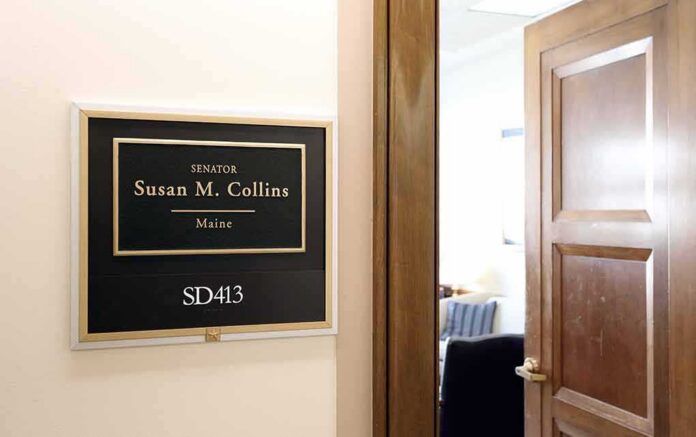
A raw debate moment in Maine put a spotlight on a familiar worry: when war moves markets, do elected leaders and their families benefit while the public pays more at the pump?
Story Snapshot
- Troy Jackson accused Senator Susan Collins of profiting from the Iran war; Collins demanded an apology.
- Reports say Collins’s husband owns defense and energy stocks; no proof shows war-driven gains.
- Collins’s votes on Iran war powers were mixed, including backing an end after 60 days.
- The exchange taps bipartisan doubts about conflicts of interest in Washington.
Debate Clash Centers On War Profits Claim
During a televised Maine Senate debate, Democratic nominee Troy Jackson charged that Senator Susan Collins and her husband were “making money” off the war in Iran. Collins, a five-term Republican, shot back, calling the claim “absolutely outrageous” and saying Jackson owed her an apology. Coverage noted that Jackson did not present supporting evidence on stage. His campaign did not add details in follow-up reports, according to national outlets tracking the debate.
The allegation rested on public reporting that Collins’s husband, Thomas Daffron, owns stock in defense and energy companies, including Boeing and RTX. Local fact checks described those holdings as a small part of the couple’s overall assets. Those reports did not document specific trades tied to the war or show realized gains from the conflict window. Without trade dates, values, or performance data, the accusation remains unproven based on what is public.
What Collins Has Voted For On Iran War Powers
Collins defended her record by pointing to votes to end the conflict. A Maine outlet reviewed Senate votes and found a mixed picture: Collins voted five times against failed war-powers resolutions pushed by Democrats earlier in the conflict, but later voted with Democrats to end the war as the 60-day War Powers Resolution threshold arrived. That record complicates simple labels, showing both procedural opposition at points and later support for limiting action.
Collins also tied her position to the War Powers Resolution timeline, which gives a president broad discretion for the first 60 days before Congress must authorize continued action. That framework shaped many of this year’s votes across the Senate, where members often split between process and policy. Such complexity helps explain why a single tally can be read more than one way in a campaign setting.
Energy Prices, Market Moves, And Public Trust
Collins acknowledged that the Iran war has raised gas and diesel prices, linking foreign conflict to costs for Maine families and businesses. That fact fuels concern on both left and right that war can enrich some investors while everyday people face higher bills. Still, the presence of stock holdings alone does not prove profiteering. Proving profit would require documents that show purchase or sale timing and gains aligned with war events, which are not in the public record cited here.
This flashpoint fits a wider ethics debate that angers voters across the spectrum. Federal research notes that lawmakers are not barred from owning individual stocks, which leaves room for perceived conflicts when votes and markets overlap. National reporting this year showed several senators trading in industries linked to their committees, deepening mistrust. That backdrop makes even unproven claims potent, because disclosure rules reveal ownership but rarely show causation or intent.
Why This Moment Matters Beyond Maine
Americans who feel shut out by rising prices and political games see a system where the rules seem to work for insiders. Conservatives point to energy costs and foreign entanglements. Liberals cite inequality and weak guardrails. Both worry that the same people who set policy can hold assets that move with those choices. That is why a single line in a debate can travel far. It speaks to a deeper fear that Washington protects itself first.
For readers, two facts can live together. First, the accusation that Collins and her husband profited from the Iran war is not proven with the public information cited so far. Second, the policy and ethics gap is real: stock ownership by lawmakers and spouses keeps creating distrust. If campaigns want clarity, they can release trade records, seek blind trusts, or back stronger rules. Until then, charges like this will keep surfacing whenever war, markets, and votes collide.
What To Watch Next
Watch for any release of Collins’s financial disclosures or spouse-asset details beyond standard summaries. Look for independent analysis of whether Boeing, RTX, or energy holdings rose during key Iran war dates, and whether any buys or sells lined up with those moves. Track future Senate votes on war powers and any push to tighten stock-trading rules. Most of all, watch whether either campaign shifts from accusations to documents. That is what can settle a claim like this.
Sources:
breitbart.com, nytimes.com, bangordailynews.com, wmtw.com, news.meaww.com, cbsnews.com, washingtonexaminer.com
© patriotwise.com 2026. All rights reserved.