
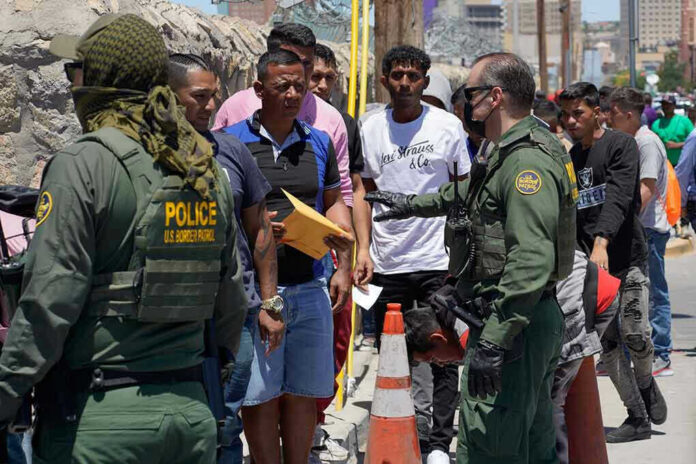
A new warning about suspected terrorists at the Canadian border puts America’s weak northern defenses back in the spotlight.
Quick Take
- Homeland Security Secretary Markwayne Mullin said authorities arrest a suspected or wanted terrorist at the northern border “almost weekly.”
- He linked that threat to cartels, fentanyl traffickers, and shifting criminal routes.
- FBI Director Kash Patel has also warned of a sharp increase in known or suspected terrorists entering through Canada.
- Earlier federal data show the northern border is a real security concern, but not every measure used by officials means the same thing.
What Mullin Said in Washington
Homeland Security Secretary Markwayne Mullin made the claim during a June 17 conversation in Washington with Canada’s Public Safety Minister Gary Anandasangaree. He said American authorities arrest a suspected or wanted terrorist at the Canada-U.S. border “almost weekly.” He also warned that criminal groups are shifting north as pressure rises on the southern border. [1][2]
Mullin’s message was blunt and familiar to anyone worried about border security. He said stronger enforcement in one place can push bad actors somewhere else. That is the core concern here: if the United States tightens one border while another stays porous, criminals and terror suspects may look for the easier path. His warning fits the broader Trump-era push to treat border control as a national security duty, not just an immigration issue.
Why the Northern Border Draws Attention
FBI Director Kash Patel has also said there has been a sharp increase in known or suspected terrorists entering through Canada. In a 2025 congressional hearing, he told lawmakers the northern border cannot be sealed physically and needs more resources. CBS News later reported that U.S. Customs and Border Protection data showed 259 terrorism-related encounters at the northern land border through July 2025, compared with 1,957 at the southern land border. [4][5]
Those numbers matter because they show the northern border is not a side issue. They also show why the public debate gets tangled fast. “Encounters,” “watch-list hits,” and “arrests” are not always the same thing. A person can be flagged, questioned, denied entry, repatriated, or arrested, depending on the case and the legal basis. That distinction is important before anyone turns a serious security problem into a talking point.
Canada Says It Has Tightened Security
Canada’s public safety minister said illegal migration from Canada into the United States has dropped by 99 percent since Ottawa rolled out a border security plan in December 2024. He also said law enforcement cooperation between the two countries is working and helping both sides manage risk. That matters because the border is only one part of the problem. Intelligence sharing, screening, and joint operations all shape what gets stopped before it turns into a threat. [1]
🚨 The U.S. arrests a terrorist coming from Canada almost every week.
U.S. Homeland Security Secretary Markwayne Mullin (@SecMullinDHS) dropping truth bombs on Public Safety Minister @gary_srp .
Time to secure the border and put #CanadaFirst. https://t.co/n5EW8Tqn7i
— Barbara Bal (@BarbaraBalCPC) June 18, 2026
Still, the facts available here do not prove that every claim of danger matches the same level of urgency. Federal records and hearing testimony show the border is under pressure, but they also show that the scale is uneven and the terminology is messy. For readers who want real security, that should raise a simple demand: officials should speak clearly, publish clean data, and stop blurring arrests, encounters, and watch-list alerts into one vague headline.
The Bigger Issue for Border Policy
The northern border has long been treated as a low-risk frontier, but post-9/11 policy changed that view. Federal and academic material describe a shift toward tighter screening, more surveillance, and more intelligence sharing after the attacks. That history explains why any sudden rise in terror-related encounters gets attention fast. It also explains why conservatives see border weakness as a broader sign of government failure, not just a regional problem. [7][14][16]
The present debate is not whether threats exist. They do. The real question is whether Washington is telling the truth about scale, frequency, and response. Mullin’s “almost weekly” line suggests a steady stream of danger. Other federal material suggests the picture is serious but more complicated. Until the government releases a clean, incident-level count, the public is left with alarming claims, partial data, and a border that still invites abuse.
Sources:
[1] Web – US Security Chief Says One Suspected Terrorist Is Arrested At Canadian …
[2] Web – Homeland Security Secretary Markwayne Mullin said the U.S. could …
[4] YouTube – WATCH: Mullin says immigration agents are ‘not actively patrolling …
[5] Web – Statement Against Markwayne Mullin for Secretary of Homeland …
[7] Web – Rep. Kiley Sends Letter to DHS Secretary on Proposal to Pull CBP …
[14] Web – Drug Smuggling, Illegal Immigration and Terrorism – House.gov
[16] Web – Terrorist suspects crossing US-Canada border at record levels
© patriotwise.com 2026. All rights reserved.