
Shockwaves rip through New York as a school security lapse nearly leads to tragedy, raising urgent questions about safety, gun access, and the erosion of local control in American education.
Story Snapshot
- FBI tip and NYPD coordination stopped a potential school shooting at Benjamin Cardozo High School in Queens before violence occurred.
- Student posted a threat on Instagram and brought a loaded handgun to school, exposing security gaps in NYC schools lacking routine weapons screening.
- Parental cooperation enabled police to recover the weapon, while the incident reignites debate on school safety policies and gun access.
- Trump administration’s shift to state-controlled education and rollback of federal oversight intensifies scrutiny of local safety measures and conservative values.
Rapid Police Response Prevents School Tragedy in Queens
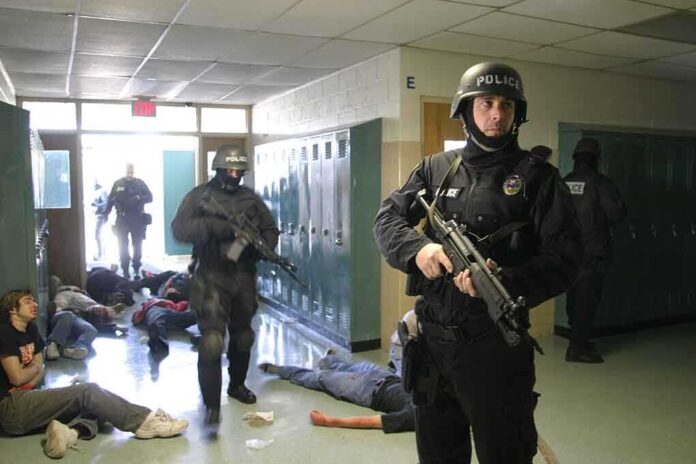
On September 18, 2025, a swift interagency response prevented a school shooting at Benjamin Cardozo High School in Bayside, Queens. A 16-year-old student posted a threat on Instagram from inside the school, provoking immediate action. The FBI traced the post and alerted the NYPD, who arrived within hours, located the suspect, and—with parental consent—found a loaded 9mm handgun with 13 rounds in his backpack. No violence occurred, but the incident exposed critical gaps in school security protocols and highlighted the vulnerability of students in facilities lacking routine weapons screening.
Law enforcement officials credited the tipster, social media monitoring, and rapid coordination for averting disaster. The student, who had no prior criminal history, is now in custody, with charges pending from the Queens District Attorney’s Office. The school immediately implemented heightened security measures and began a review of how the firearm was brought onto campus. As parents, staff, and students grapple with psychological aftershocks, city officials, including Mayor Eric Adams and NYPD Commissioner Jessica Tisch, have publicly recognized the importance of early intervention and cross-agency cooperation. The event amplifies community demands for accountability and transparency in school security practices.
Security Lapses and Local Control: Policy Implications Under Trump
The incident reignites debate over school security protocols in the wake of the Trump administration’s dramatic reshaping of education policy. Trump’s return to office brought an executive order dismantling the federal Department of Education and shifting power—and responsibility—back to states and local communities. While supporters cite this as a victory for parental choice and freedom from “woke” federal mandates, critics argue that the move risks undermining critical oversight and consistent standards for student safety. The lack of routine weapons screening at Cardozo High exemplifies the consequences of decentralized policy and resource gaps, especially when federal funding and oversight are reduced.
States now face increased pressure to address school safety with fewer federal resources and less guidance. Conservative advocates praise the rollback of progressive social experiments and administrative bloat, seeing it as a restoration of traditional values and local sovereignty. However, the Cardozo incident raises concerns about whether local authorities have adequate tools and funding to prevent future threats. As gun access and youth violence remain politically charged issues, parents and communities are left to demand more rigorous, locally-tailored security measures while safeguarding constitutional rights.
Social Media Threats, Gun Access, and the Challenge for Family Values
Recent years have seen a spike in social media threats and youth access to firearms, with incidents like Cardozo’s highlighting the intersection of online behavior and real-world danger. The trend puts pressure on schools to balance privacy, mental health support, and effective monitoring. Law enforcement’s ability to quickly track digital threats and intervene is vital, but ongoing debate persists over universal weapons screening and surveillance versus protecting individual liberty. Conservative families express frustration with policies that seem reactive rather than preventive, emphasizing the need for common-sense solutions that protect children without eroding constitutional freedoms.
The Cardozo case underscores the necessity for parental engagement and cooperation with authorities, a cornerstone of community-driven safety. As the Trump administration’s policies reshape the landscape, the challenge for American families is ensuring schools uphold core values—security, responsibility, and freedom—while resisting government overreach and preserving the right to self-defense. The political and social fallout from this incident will likely influence ongoing debates about how best to secure schools and uphold American principles in an era of rapid change.
FBI tip leads NYPD to 16-year-old arrested with loaded gun inside school; Great work stopping school shooting before it happened!!!https://t.co/9i2S8U7aOe
— Drew (@DHawthorne1656) September 19, 2025
Ongoing investigations continue into how the student obtained the weapon and the adequacy of local protocols. While Cardozo High now operates under heightened security, the broader question remains: will decentralized, state-run education systems be able to prevent similar threats, or will gaps persist as the federal government steps back? Experts and officials urge vigilance, transparency, and a careful balance between liberty and security as the nation adapts to new realities in school safety and governance.
Sources:
16-year-old with loaded gun threatened to ‘shoot up’ New York City high school, police say
Benjamin Cardoza High School threat: Student arrested after threats, gun found in backpack