

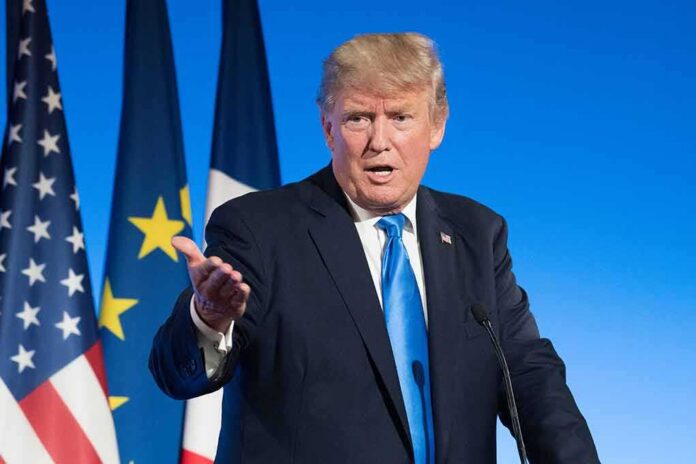
President Trump said he “may” meet North Korea’s Kim Jong Un, reviving high-level diplomacy that once paused nuclear tensions but never solved them.
Story Snapshot
- Trump said a meeting with Kim Jong Un “may” happen, signaling fresh outreach.
- Past Trump-Kim talks began after South Korea relayed Kim’s eagerness to meet in 2018.
- The first summit produced a broad pledge on denuclearization but no roadmap.
- The new hint is not a set plan, but it resets the conversation with Pyongyang.
Trump Signals Openness To Another Kim Meeting
President Trump told reporters he “may” meet North Korean leader Kim Jong Un. He added that would be “an exciting one,” and he said he gets along with Kim. The statement points to possible leader-to-leader talks but does not set a date or place. The remark fits Trump’s style of using public hints to open a door. One short sentence can shift focus from stalemate to contact. The White House has not issued a formal schedule.
Trump’s comment echoes the start of his 2018 outreach. That effort began after South Korea’s national security adviser said Kim wanted to meet Trump “as soon as possible,” and Trump agreed to pursue denuclearization in person. The dynamic then moved quickly from a public signal to a confirmed summit. The latest hint suggests a similar move is possible. It also suggests Washington sees value in direct talks at the leader level to break through old ruts.
What Earlier Summits Achieved And Where They Fell Short
The first Trump-Kim summit in Singapore in June 2018 produced a joint statement. Both sides pledged to work toward peace and denuclearization of the Korean Peninsula. The document created hope and lowered tensions. It did not include a step-by-step plan, firm timelines, or verification tools, which limited progress after the cameras left. Even so, it showed that top-level meetings can halt the slide toward crisis, at least for a time.
Analysts note that North Korea diplomacy often moves in cycles. Leaders create momentum with big meetings, then hit walls over sanctions, inspections, and nuclear definitions. That pattern held after Singapore. Talks later stalled when each side asked for major steps from the other first. The lack of a detailed roadmap made deadlock more likely. This history sets fair expectations now: a meeting can ease risk and open channels, but results hinge on hard technical work afterward.
Why A New Meeting Matters To Americans Across The Spectrum
Families want safety from nuclear threats and missile tests. Businesses want stable markets and trade routes in Asia. Service members and veterans want fewer flashpoints that can pull the nation into war. A leader-level meeting can reduce the chance of a sudden crisis. It can also test whether North Korea will take real steps, not just make promises. Both conservatives and liberals can agree that peace through strength requires clear goals, strong verification, and accountability.
North Korea's Kim showcases missile capable of reaching US as Trump signals possible meeting https://t.co/rszydA9pGT Trump is expected to attend the Asia-Pacific Economic Cooperation summit in China in mid-November, where he may meet North Korean leader Kim Jong Un.
— 9DASHLINE (@9DashLine) October 14, 2026
Many readers also worry about show over substance. Washington often celebrates headlines while problems drag on. Trump’s hint revives a tool that once cut tension but did not end the nuclear issue. The lesson from 2018 is simple: pair summit theater with concrete work. That means linking any future meeting to practical tasks, like caps on warhead production, site access for inspectors, and exchanges that build trust only after real steps are verified. One sentence can start that path, but plans must carry it forward.
Sources:
pbs.org, transcripts.cnn.com, npr.org
© patriotwise.com 2026. All rights reserved.