A massive 7.8 earthquake just killed at least 37 people in the Philippines, and the way it shook one man’s home shows how fragile life — and basic preparedness — really are.
Story Snapshot
- A magnitude 7.8 quake off southern Philippines killed at least 37 people and injured hundreds.[1][2][3][6][7]
- Homes “swayed,” buildings collapsed, and landslides buried families as more than 32,000 people fled for safety.[1][2][3][5][7][9]
- Rescuers are still pulling survivors from rubble while officials warn the death toll could rise further.[1][3][5][6]
- The strongest Philippine quake in about 50 years triggered tsunami alerts and exposed weak infrastructure.[1][3][5][8]
Powerful quake turns homes into swinging traps
On Monday morning, a magnitude 7.8 earthquake struck off the coast of Maasim in Sarangani province, shaking the southern island of Mindanao at 7:37 a.m. local time.[2][5][7] The United States Geological Survey measured the quake’s center offshore at a depth of about 20 to 33 kilometers, strong enough to rattle buildings far inland.[2][5] Survivors described homes that felt like they were “swaying,” as walls cracked and ceilings dropped debris around families with almost no warning.[1][7]
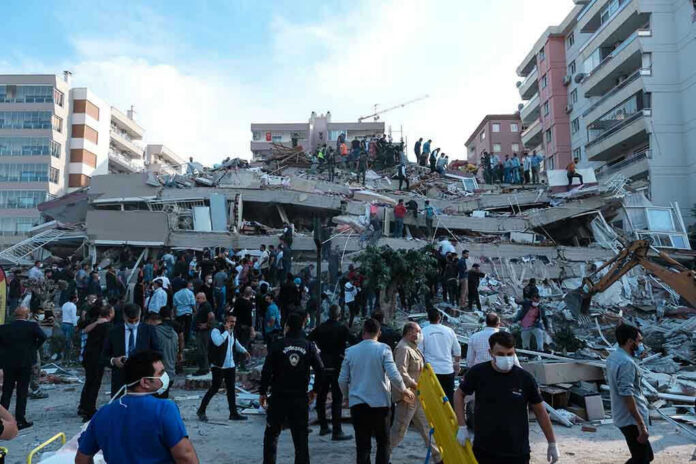
Officials say this was one of the strongest quakes to hit the Philippines in roughly half a century, rivaling the deadly 1976 Moro Gulf disaster.[1][3][6] The shaking set off landslides in mountain towns and caused small buildings to collapse in cities, trapping people in homes, schools, and shops.[1][2][3] Panicked residents ran into the streets as sirens blared and emergency alerts warned of both aftershocks and possible tsunami waves along the southern coast.[4][5]
Rising death toll, “swaying” homes, and villages buried in mud
By Tuesday, Philippine disaster officials confirmed at least 37 people dead, with the number expected to keep climbing as teams reach more remote areas.[1][3][5][6] The Office of Civil Defense reported that nearly 500 people were injured and four remained missing, while rescue crews searched for anyone still under collapsed structures.[2][3][5][6] Local media and wire reports note that early counts were lower, but the toll rose as access improved and more bodies were recovered.[3][5][6]
General Santos, a coastal city of more than 700,000 people, suffered heavy damage, with at least 13 deaths blamed on falling debris and collapsed buildings.[1][2] In nearby Sarangani province, at least 18 people died when a landslide, triggered by the quake, buried houses in the mountainside town of Glan.[1][3][5][7] Disaster officials say around 2,000 houses were affected, more than 400 totally destroyed, along with at least 117 government sites and about 20 bridges damaged or closed.[3][5]
Tsunami alerts, mass displacement, and lessons for Americans
The offshore location and strength of the quake quickly triggered tsunami alerts across the Philippines and neighboring countries, including Indonesia, Japan, and Australia.[3][5] Waves up to about 1.4 meters above normal tide levels were recorded in several Philippine coastal areas before the local alert was lifted later that day.[5] Authorities still urged people to stay away from damaged shorelines and warned that strong aftershocks, including one as large as magnitude 6.7, could continue for more than a month.[5]
Following a 7.8M #earthquake yesterday near Sarangani in the #Philippines, there are reports of 37 deaths, 488 injuries and 33.5k displaced.
HF has so far provided emergency food rations for impacted fishing communities in Simunul. pic.twitter.com/4tYzpJBIXL
— Humanity First International (@HFI1995) June 9, 2026
More than 32,000 people were displaced, many of them crowding into emergency shelters after homes cracked, shifted, or were left leaning and unsafe.[1][2][9] Reports from General Santos and other towns show families sleeping in schools, tents, and church yards, while engineers race to inspect thousands of classrooms before allowing students back inside.[1][2][3] For Americans watching from afar, the images of “swaying” houses and buckled roads are a sharp reminder of why strong infrastructure, honest reporting, and real preparedness matter more than feel-good talking points.
Sources:
[1] YouTube – Earthquake survivor says his home was ‘swaying’ as 37 killed in the …
[2] Web – 32,000 people displaced by the Philippine earthquake that killed at …
[3] YouTube – 37 Dead, Many Injured In 7.8 Magnitude Earthquake …
[4] YouTube – At least 32 dead after major earthquake hits southern Philippines
[5] Web – An earthquake of magnitude 7.8 struck the Mindanao … – Instagram
[6] Web – China Xinhua News – Facebook
[7] Web – List of earthquakes in the Philippines – Wikipedia
[8] Web – Fact check: Real vs. fake Philippines earthquake footage | CBC.ca
[9] Web – Deadly quake strikes Philippines on first day of school year – UN News
© patriotwise.com 2026. All rights reserved.