As Spain’s deadliest Andalusia wildfire in decades left tourists burned in their cars and on foot, officials and grieving families are now locked in a bitter fight over whether the victims made tragic mistakes—or were failed by a system that never gave them a real chance to survive.
Story Snapshot
- At least 11–12 people, many foreign tourists, died in a fast-moving wildfire in southern Spain’s Andalusia region.
- Four victims were found trapped in a burned-out car, while others died on foot after abandoning vehicles as they tried to escape.
- Regional officials say many victims ignored shelter-in-place advice, but they have not released the actual evacuation orders.
- Experts and past studies suggest a wider pattern where authorities blame victim behavior instead of fixing deeper failures in fire management.
How a holiday landscape turned into a deadly fire trap
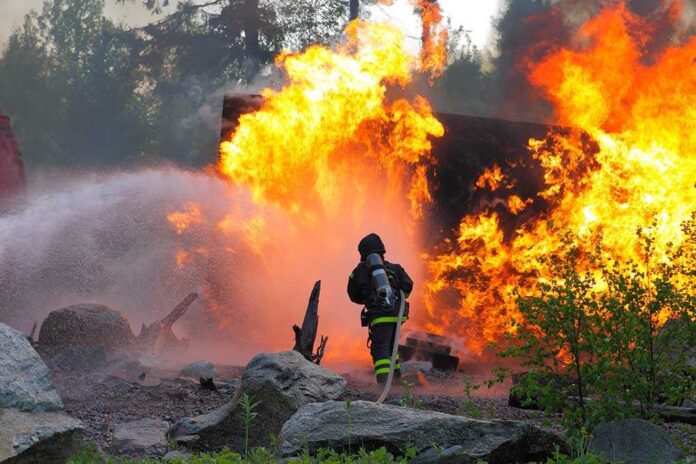
The wildfire hit the Los Gallardos and Bédar area of Almería, a coastal region popular with foreign tourists and retirees. Authorities say at least 11 to 12 people were killed and around 19 to 23 remain missing, making it one of Andalusia’s deadliest fires in decades. Many victims are reported to be foreign nationals, including British tourists, who were staying in villas and campgrounds scattered across rugged hills. Strong winds, near 40-degree heat, and dry brush turned those hills into a fast-burning tunnel of flame.
Witnesses and local media describe a fire that moved “like gunpowder” and “like a Formula 1 car,” racing about 15 kilometers in just two hours. About 3,200 hectares of land burned as gusts up to 70 kilometers per hour pushed flames through ravines and over roads. In such conditions, fire experts say escape routes can become deadly in minutes, especially for people who do not know the local terrain. Tourists driving rental cars or towing campers suddenly found themselves in narrow roads with flames closing in from both sides.
Victims burned in cars and on foot as they tried to flee
Regional emergency chief Antonio Sanz said seven victims were found dead on foot after abandoning their cars, while four others died inside a burned-out vehicle. These findings suggest people tried to drive away, then ditched their cars when smoke and heat made the road feel like a trap. Officials say some victims may have ignored advice to stay indoors or use authorized evacuation routes, choosing back roads or private driveways instead. Social media posts and some news outlets repeated the phrase that foreign tourists “ignored shelter-in-place instructions,” turning the tragedy into a debate over blame.
At the same time, reporters on the ground highlight how little warning many visitors seem to have had before the flames reached them. There is no public record yet of exactly when text alerts, sirens, or door-to-door warnings went out in English or other languages. For families overseas, that gap matters: they want to know whether their loved ones chose to ignore clear orders or simply never received clear, understandable guidance in time. Until those emergency logs are released, both the “they ignored advice” story and the “they were trapped no matter what” story rest on partial information.
Why officials push “victim negligence” – and what that means for trust
The focus on victims’ decisions fits a pattern seen before in Spain and Portugal, where officials often say people died because they tried to flee in cars instead of staying put. A study of hundreds of fire deaths in Southern Europe found most civilians died from burns and suffocation while moving, not sheltering, which authorities sometimes present as proof that people “should have listened” to orders. But that same research warns that fire policies, land management, and warning systems need deep reform, because unmanaged forests, scattered homes, and weak evacuation planning make safe choices hard or even impossible.
In Spain, most fires are linked to human causes such as poor infrastructure, lack of forest maintenance, and stretched regional fire budgets. Rural land often sits overgrown and unmanaged, while tourism brings more people into high-risk zones without matching investments in warning systems or escape routes. When a blaze finally hits, it is easier for leaders to point to individual mistakes—wrong turn, late departure, ignored alert—than to admit years of underfunding, weak planning, or slow action on climate-driven fire risk. That dynamic feeds the growing belief, shared by many conservatives and liberals, that governments protect themselves first and citizens second.
Shared frustrations on both sides of the political divide
For older conservatives watching from the United States or Europe, this Spanish disaster can feel like one more proof that globalist leaders talk about climate and safety but fail to maintain power lines, manage forests, or build real evacuation plans. Many see tourists burned in cars as victims of elite negligence, not random fate. For older liberals, the story raises different but overlapping fears: that public services are hollowed out by budget cuts, that safety nets vanish in crises, and that foreign visitors and minorities are blamed when systems fail them.
Spain’s deadliest wildfire in ~20 years: 12 known dead in Andalusia. Most victims suspected foreign nationals four believed British amid tourists and residents from Germany, UK, Netherlands, Belgium.
Officials went door to door on stay-or-evacuate. Some refused to leave; others… pic.twitter.com/jgURFPlM7W
— Packet Commander ⚡️ (@JAVI_MEI) July 10, 2026
Both groups can agree on one thing: when the state controls the emergency system, the roads, and the warnings, it carries a heavy duty to prove it did its job. In Andalusia, officials have shared dramatic details about how and where people died, but not the full record of what they were told before the flames arrived. Until those orders and logs are released, families and citizens will keep asking hard questions about whether this was a tragedy no one could stop—or another disaster where ordinary people paid the price for choices made far above their heads.
Sources:
youtube.com, euronews.com, pbs.org, instagram.com, bbc.com, facebook.com, france24.com, reuters.com, vpm.org
© patriotwise.com 2026. All rights reserved.