U.S. Navy pilots boldly reject advanced autopilot for carrier landings, trusting human skill over machine precision in life-or-death scenarios.
Story Highlights
- Navy’s JPALS and “Magic Carpet” systems can execute hands-off autolandings on pitching carriers, yet pilots refuse full reliance.
- Former EA-18G pilot Adam Daymude declares “Hell, no!” citing spectacular failures in turbulence and unpredictable conditions.
- Manual control preserves irreplaceable “seat-of-the-pants” intuition that algorithms cannot replicate.
- This stance upholds Navy readiness amid rising global threats, prioritizing warfighter judgment over tech dependency.
Autopilot Technology Meets Carrier Realities
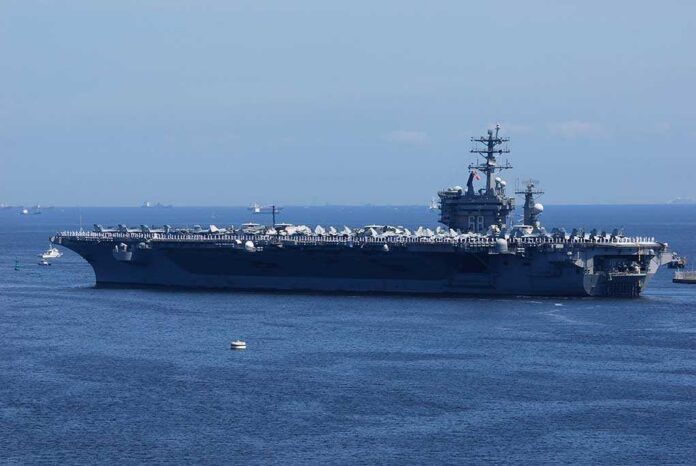
U.S. Navy pilots land F/A-18 Super Hornets on Nimitz-class carriers like USS Harry S. Truman using tailhooks and arresting wires. Systems such as Joint Precision Approach and Landing System (JPALS) and Precision Landing Modes (“Magic Carpet”) enable assisted or fully hands-off autolandings. These tools compute 3-degree glideslopes, carrier motion, and wind shifts for precision recoveries. Development spans decades, rooted in 1912 gyroscope tech by Lawrence Burst Sperry. Yet operational use remains limited to ideal conditions on pitching, rolling decks in combat zones.
Pilots’ Firm Refusal to Trust Automation
Former EA-18G Growler pilot Adam Daymude, who collaborated on simulator algorithms, states pilots inherently refuse autopilot for carrier landings. He explains systems fail spectacularly in non-ideal weather, like 25-knot winds or deck pitching, where auto-throttle cuts power unexpectedly. Daymude emphasizes machines lack human intuition for instinctive adjustments, such as power additions during wake turbulence. Navy mandates manual proficiency training, with commanding officers enforcing “manual passes” even for experts. This cultural distrust prioritizes safety and skill retention over tech convenience.
Historical Evolution and Expert Insights
Autopilot originated in 1912 with Sperry’s gyroscopic stabilizer, demonstrated in pilotless flights. Naval aviation advanced arresting gear for jet recoveries amid variable seas. Recent operations, including 2024 USS Truman recoveries, showcase manual landings guided by landing signal officers. Experts like Aviation Geek Club’s Dario Leone highlight the nerve and precision demanded. SlashGear notes PLM reduces landing attempts under 10 in calm conditions but stresses manual backups for malfunctions. Consensus favors human oversight in high-stakes environments.
Pilots value “seat-of-the-pants” feel that simulators cannot fully model, ensuring reliability when tech falters. This approach sustains elite aviator culture amid AI advances.
‘I Won’t Use It’: The U.S. Navy’s Autopilot Can Land a Jet on an Aircraft Carrier. Pilots Won’t Use It.https://t.co/bzMVEtOpEl
— Harry J. Kazianis (@GrecianFormula) April 13, 2026
Implications for Military Readiness
Maintaining manual skills reduces short-term failure risks in dynamic operations, preserving operational readiness for Navy squadrons like VFA-11 and VFA-210. Long-term, it delays full automation, countering over-reliance on AI amid global tensions. Economically, it sustains training costs versus potential savings, while socially reinforcing warfighter autonomy. Politically, pilots’ caution signals prudence in entrusting national defense to algorithms, echoing broader concerns over elite-driven tech agendas that sideline proven human judgment. This human-first stance bolsters America’s military edge.
Sources:
Why U.S. Navy Pilots Refuse to Use Autopilot for Aircraft Carrier Landings
US Navy Aircraft Carrier Jet Landing Autopilot
US Navy Pilots Training No Longer Need Land Aircraft Carrier Graduate