
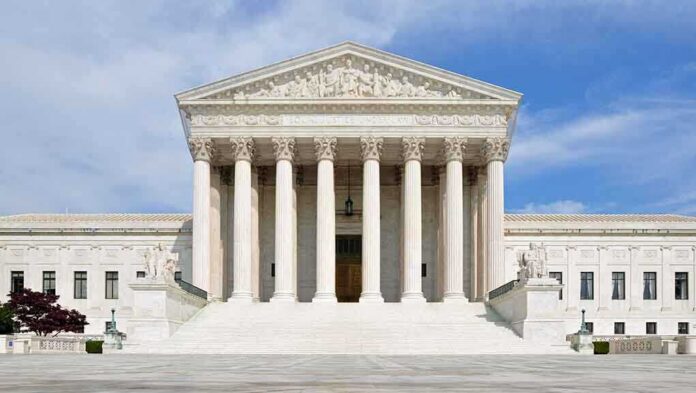
Supreme Court justices openly clash in fiery opinions, exposing deep divisions over election rules that could reshape congressional power amid 2026 midterms.
Story Snapshot
- 6-3 ruling strikes down Louisiana’s second majority-Black district as unconstitutional racial gerrymander under Voting Rights Act Section 2.
- Court accelerates judgment implementation, shortening 32-day delay to enable faster map redraw during ongoing primaries.[1][5]
- Justice Jackson dissents solo, warning of “chaos” and judicial overreach into elections.[5]
- Justice Alito concurs sharply, labels Jackson’s critique “baseless and insulting.”[1][4]
Louisiana Redistricting Ruling
The Supreme Court ruled 6-3 on April 29, 2026, in Louisiana v. Callais that the state’s congressional map creating a second majority-Black district violated the Constitution. Justice Samuel Alito wrote the majority opinion, joined by conservative justices. The map, known as SB8, relied too heavily on race without a compelling interest under Section 2 of the Voting Rights Act. This shifted Section 2 claims from results-based tests toward proving intentional discrimination.[1]
Louisiana drew the map after lower courts ordered a second Black-majority district to comply with Voting Rights Act protections. The Trump administration and state officials challenged it as racial gerrymandering under the Fourteenth Amendment. The ruling blocks such race-based districting unless strict scrutiny is met.[2]
Accelerated Judgment Sparks Dissent
On May 4, 2026, the Court issued an order in docket 25A1197 granting a request to send the judgment to lower courts immediately, bypassing the standard 32-day Rule 45.3 delay.[5] Louisiana did not oppose the application from Callais plaintiffs. This allows quicker redrawing of districts amid 2026 primaries, where ballots mailed as early as April 1.[5]
Justice Ketanji Brown Jackson dissented alone, arguing the move created chaos in ongoing elections. She wrote that the Court abandoned restraint, appearing to endorse Louisiana’s rush to pause elections and redraw maps.[5] Jackson cited rare prior grants of such requests—only twice in 25 years over objection—and invoked Purcell principles against late election changes.[4]
Alito’s Rebuttal and Broader Tensions
Justice Alito, joined by Justices Thomas and Gorsuch, concurred to counter Jackson. He called her charges of unprincipled power use “groundless and utterly irresponsible.” Alito noted Rule 45.3 is a default, waivable for cause, and delaying would favor the unconstitutional map, creating its own partiality.[4][5] He questioned any violated principle, dismissing fears of partisan criticism.[1]
This exchange highlights frustrations across political lines with institutions prioritizing process over swift justice. Conservatives see victory against race-based maps; liberals decry weakened minority protections. Both sides question if courts serve elites or voters, echoing distrust in a government failing everyday Americans on core democratic principles.[3]
This lady was chosen because she was
FEMALE &
BLACK
••••••••
Ketanji Brown Jackson is making headlines after a fiery dissent in a major SCOTUS voting rights case tied to Louisiana redistricting.@kayleighmcenany @EmilyCompagno @IngrahamAngle @FoxNews@JesseBWatters— The Labrador Retriever (@OnielRichards) May 6, 2026
The ruling fits patterns of over 200 Section 2 challenges since 1982, surging post-Shelby County, often pitting Republican states against dilution claims. With 2026 midterms looming and GOP controlling Congress under President Trump, outcomes may fuel perceptions of a captured judiciary, deepening divides on whether rules protect or manipulate the vote.[2][3]
Sources:
[1]
[2] The Supreme Court’s Callais decision sets new framework for racial …
[3] Louisiana v. Callais – Wikipedia
[4] Samuel Alito Had No Answers For Ketanji Brown Jackson’s Latest …
[5] [PDF] 25A1197 Callais v. Louisiana (05/04/2026) – Supreme Court