
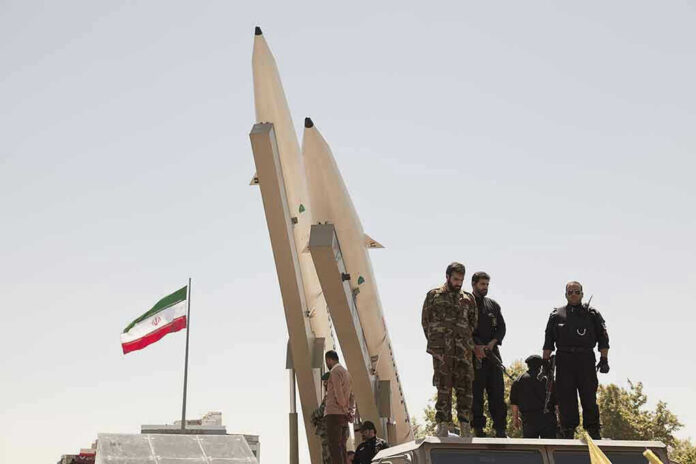
patriotwise.com — Iran’s president is reportedly trying to quit after warning that the Islamic Revolutionary Guard Corps has seized total control—an alarming sign of a militant regime tightening its grip while Washington watches for threats against Americans and allies.
Story Snapshot
- Multiple outlets report President Masoud Pezeshkian sought to resign, citing Islamic Revolutionary Guard Corps dominance [2][3][8].
- London-based and regional reporting describe a letter to the Supreme Leader’s office alleging exclusion from key decisions [10][12][13].
- Official Iranian confirmation is absent; state-linked denials and uncertainty persist [1][8][12].
- If true, the shift cements military rule in Tehran with wider risks for U.S. security and global energy markets [11].
Competing Reports Indicate a Presidency Sidelined by Security Chiefs
Regional and international outlets state that Iranian President Masoud Pezeshkian either weighed or sought resignation after being shut out of wartime and strategic decision making by the Islamic Revolutionary Guard Corps, the regime’s dominant security apparatus [2][3]. A live report log in Israel said he warned that governance had fallen under full Islamic Revolutionary Guard Corps control and that he lacked authority to govern effectively [8]. Aggregated coverage echoed the same core claim: the security establishment eclipsed the elected presidency [10].
London-based and diaspora reporting further asserted that Pezeshkian’s alleged letter was submitted to the office of Iran’s Supreme Leader, escalating rumors of a constitutional crisis inside Tehran’s opaque power structure [12][13]. Secondary write-ups relayed that the move followed intensifying pressure and isolation of the president’s team in the midst of regional conflict and internal factionalism [10]. These accounts, while overlapping, rely on anonymous sourcing or external outlets outside Iran, a common feature when the regime restricts verifiable access [12].
Verification Gaps: Tehran’s Silence and State-Linked Pushback
State authorities have not issued an official, on-the-record confirmation that Pezeshkian resigned or that a resignation letter was accepted, which leaves the claims short of hard proof [1]. Real-time reporting and social chatter noted denials from regime-aligned channels, underscoring a contested information space [8]. Given Iran’s history of censorship and compartmentalized decision making, the lack of documents or an authoritative announcement keeps this story in the realm of credible but unverified reporting rather than established fact [1].
Earlier background coverage detailed mounting political erosion around Pezeshkian’s government, portraying a presidency hemmed in by hard-liners and security elites since at least late 2025 [5]. Public biographies confirm his rise to the presidency in 2024 and frame the broader struggle between elected institutions and the Islamic Revolutionary Guard Corps’ entrenched influence across the military, economy, and foreign operations [6]. That structural imbalance adds weight to the plausibility of the sidelining claims even as formal confirmation remains absent [5].
Why This Matters for U.S. Interests, Security, and Energy Stability
A verified transfer of real authority to the Islamic Revolutionary Guard Corps would further militarize Iran’s regional posture, potentially accelerating proxy activity against United States partners, shipping lanes, and Israel. Market watchers warn that such a consolidation, if proven, could strain energy supplies and elevate price volatility as risk premiums rise on Middle East production and transit routes [11]. That scenario demands vigilance from Washington and allied capitals as they calibrate sanctions enforcement, maritime security, and missile defense readiness.
🌏 Global Update on Iran/Us war 🌏
Reports have it that Iran's President Masoud Pezeshkian has reportedly submitted a resignation letter to the Supreme Leader's office, citing his exclusion from major decisions and inability to fulfill his duties amid IRGC dominance.
The claim,… pic.twitter.com/4an0H3gIlf— The 7 Daily Pulse (@7DailyPulse) May 31, 2026
For American readers, the lesson is straightforward: regimes hostile to the United States thrive when unaccountable security structures overpower civilian rule. That model fuels repression at home, terror sponsorship abroad, and instability that hits American wallets through energy shocks. The Trump administration’s task is to protect U.S. forces, safeguard sea lanes, tighten sanctions on Islamic Revolutionary Guard Corps revenue streams, and stand with regional partners—without writing blank checks or tolerating appeasement that rewards aggression.
Sources:
[1] Web – New Report: Iran President Pezeshkian Steps Down Citing Total IRGC …
[2] YouTube – Iran Prez Pezeshkian Quits? Accepts DEFEAT After Larijani Killing …
[3] Web – Iran’s President Masoud Pezeshkian Weighs Resignation Amid …
[5] Web – Khamenei Nixes U.S. Negotiations, Sparks Rumors of Pezeshkian’s …
[6] Web – Political erosion mounts in Pezeshkian’s government as officials …
[8] Web – Iran’s President Pezeshkian Seeks Resignation Amid Leadership …
[10] YouTube – Who Pulls The Strings In Iran? Pezeshkian Sidelined As IRGC …
[11] Web – Iran’s Pezeshkian Reportedly Submits Resignation to Khamenei …
[12] Web – Potential Resignation of Iranian President Signals Shift in Political …
[13] Web – Iran’s president offers resignation, citing total takeover by IRGC …
© patriotwise.com 2026. All rights reserved.