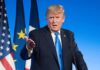
President Trump declared the United States the “guardian angel” of the Strait of Hormuz and announced a 20% fee on all ships passing through — but his own Secretary of State says such tolls are illegal under international law.
Story Snapshot
- Trump claimed the U.S. “controls” the Strait of Hormuz and demanded allies repay 50 years of unpaid protection costs.
- He announced a 20% fee on all cargo passing through the strait — a move Secretary of State Marco Rubio has said is prohibited under international law.
- Trump threatened to “blow up” Oman if it tried to assert control over the waterway, which carries a large share of the world’s oil supply.
- U.S. intelligence sources warned that Iran is unlikely to ease its grip on the strait anytime soon, directly contradicting Trump’s claim of U.S. control.
Trump Claims the U.S. Runs the World’s Most Important Waterway
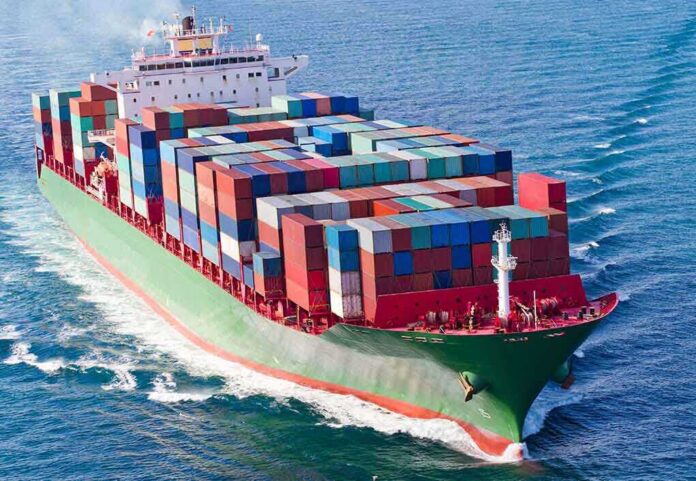
In a Fox News interview, President Trump said the United States is the “guardian angel” of the Strait of Hormuz and should be paid back for decades of protecting it. He also announced a 20% fee on all cargo ships using the route. The strait is a narrow passage between Iran and Oman. About 20% of the world’s oil flows through it, making it one of the most critical shipping lanes on Earth.
Trump went further, stating that “the United States of America controls the Strait of Hormuz, not Iran.” He said the U.S. Navy had successfully moved more than 100 million barrels of oil through the waterway. He also warned that Oman would face military consequences if it tried to assert control, saying the U.S. would “have to blow them up.” These are some of the most direct claims any U.S. president has made about controlling an international waterway.
A Policy That Contradicts Itself — and International Law
Trump’s statements contain a clear tension. In one breath, he called the strait “international waters” where “nobody’s going to control it.” In the next, he said the U.S. controls it and will charge a toll. Those two positions don’t fit together. More importantly, Secretary of State Marco Rubio publicly stated that tolls on international waterways are prohibited. That means the President and his own top diplomat are on opposite sides of the same policy question.
International law backs Rubio’s position. Under the United Nations Convention on the Law of the Sea (UNCLOS), all ships have the right to pass through international straits without paying fees. The U.S. has enforced that principle for decades through its Freedom of Navigation program, which has challenged excessive maritime claims by more than 35 countries. Charging a toll would flip that long-standing U.S. policy on its head — and could invite legal challenges from every nation that uses the route.
Iran’s Grip Remains Strong Despite U.S. Claims
U.S. intelligence sources told Reuters that Iran is not expected to reopen the Strait of Hormuz anytime soon. That directly undercuts Trump’s claim that the U.S. has taken control. Analysts at the Royal United Services Institute, a respected defense think tank, put it plainly: the strait remains, “in every practical sense, Iranian-controlled.” Iran has also proposed a five-point plan asserting its own sovereignty over the waterway and has been charging ships fees for safe passage.
Trump announces US blockade of Iranian ships in the Strait of Hormuz + 20% toll on all other vessels.
This narrow passage between Iran and Oman carries ~20% of the world’s oil.
The move could disrupt global supply and push prices higher.#StraitofHormuz pic.twitter.com/Gu8Tfui5cL
— MHM (@Moe_Hasan1) July 13, 2026
The gap between Trump’s words and the reality on the water is significant. The U.S. Navy has conducted escort missions and freedom-of-navigation operations in the region, but military experts note that actually forcing the strait open against Iranian opposition would be a massive and costly undertaking. Iran has missiles, mines, and fast-attack boats positioned to threaten any ship in the narrow passage. The U.S. military’s own assessments acknowledge that Iran has the tools needed to close the strait if it chooses to.
Why This Matters to Everyday Americans
The Strait of Hormuz is not just a foreign policy problem. When it’s blocked or threatened, oil prices rise. Markets have already pushed prices above $70 per barrel following the latest tensions, with some analysts warning of a path toward $100. Higher oil prices mean higher gas prices and higher costs for nearly everything shipped by truck or plane. Americans on both sides of the political aisle feel that pain directly at the pump and at the grocery store.
The deeper question here is one of honesty and competence. When a president makes bold claims about controlling a waterway that U.S. intelligence says Iran still holds, and proposes fees that his own Secretary of State says are illegal, it’s fair to ask: who is actually steering U.S. policy? The disconnect between the White House’s public declarations and the facts on the ground is exactly the kind of government dysfunction that leaves millions of Americans — left and right — feeling like Washington is more focused on headlines than on results.
Sources:
apnews.com, npr.org, youtube.com, newrepublic.com, brookings.edu, aljazeera.com, reuters.com
© patriotwise.com 2026. All rights reserved.