
When America’s top diplomat warns that a U.S.–China clash could be “really catastrophic for the world,” it signals just how close two superpowers may be drifting toward a crisis that neither ordinary Americans nor ordinary Chinese want.
Story Snapshot
- Secretary of State Marco Rubio says the United States and China must keep talking to stop dangerous disputes from turning into open conflict.
- Rubio admits “big differences” on trade, Taiwan, and sea lanes but stresses that any major fight between the two largest economies would hit workers and families across the globe.
- Both sides are preparing a high-stakes Trump–Xi summit, hoping careful diplomacy can cool tensions without either government backing down on its core interests.
- For Americans who already feel betrayed by distant elites, this rivalry shows how global power games can threaten jobs, prices, and peace while Washington and Beijing argue over control.
Rubio’s Warning: Conflict Would Be Catastrophic
Secretary of State Marco Rubio has spent this week in Manila telling reporters that the United States and China must manage their disputes “very carefully” because any serious conflict could shake the world economy and global security. He described the two nations as powerful nuclear states with huge militaries and the largest economies on Earth, meaning even an economic showdown would hurt many other countries, not just Washington and Beijing. In a video from the ASEAN meetings, Rubio went further, saying leaders have “an obligation” to avoid a clash that could become “really catastrophic for the world.”
Rubio’s language stands out in a time when many Americans feel the federal government cannot even manage problems at home, let alone prevent a global disaster. He did not downplay the danger; he spoke openly about “big differences” that will last “for the foreseeable future,” especially on trade and freedom of navigation. Yet his main point was clear and simple: without steady communication, these tensions could spin out of control. For families worried about inflation, supply chains, and the risk of war, his remarks were a reminder that the stakes of U.S.–China rivalry are not abstract theories. They are about real lives and real livelihoods.
Talking Through Deep Differences With Beijing
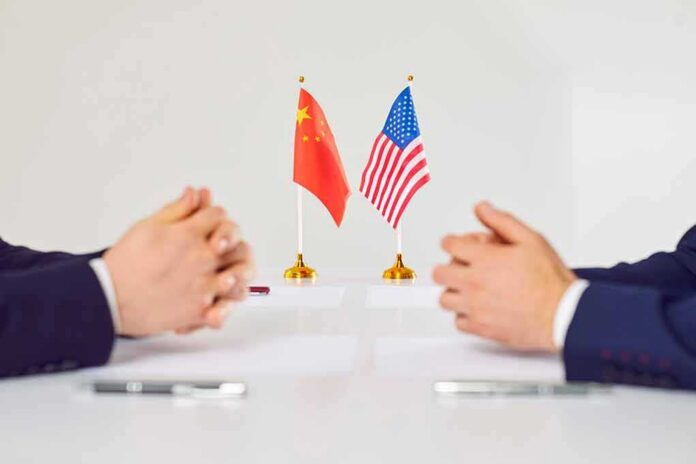
Rubio met Chinese Foreign Minister Wang Yi on the sidelines of a gathering of Asian foreign ministers to prepare a possible summit between President Trump and Chinese leader Xi Jinping later this year. After the meeting, he said the United States and China have “great differences” that must be “worked through” and “managed” so they never become open conflict. Those differences include Taiwan, trade rules, and control of key sea routes where both sides send warships and cargo ships. According to a Chinese summary, Wang pushed Washington to “respect China’s core interests” and handle disagreements in a way that addresses Beijing’s concerns.
Rubio’s comments show a mix of toughness and caution that mirrors long-term U.S. policy. He has called China America’s “biggest threat” in the past and remains critical of its human rights record and economic practices. Now, as secretary of state under President Trump, he is also stressing “responsible statecraft” and “mature” management of the relationship. He told Japanese broadcaster NHK that disputes, “economic or otherwise,” between two great powers can “dramatically, negatively” affect other countries, so Washington wants “stability,” “peace,” and “prosperity” instead of turning the Indo-Pacific into a battlefield. That balance—warning about China while insisting on dialogue—is the tightrope U.S. officials have walked for years.
Economic Links and Military Risks Raise the Stakes
Rubio reminded audiences that the United States and China are locked together economically even as they compete and clash. American companies depend on Chinese factories and markets, while China relies on U.S. demand and technology. Any sharp break—like a trade war spiraling out of control—would mean higher prices, lost jobs, and more stress for families already struggling with inflation and rising energy costs. At the same time, both countries are expanding their armed forces and nuclear arsenals, and they face off in places like the South China Sea and around Taiwan, where a mistake or misread signal could trigger a military crisis.
For conservatives, the fear is that “globalists” and corporate elites will keep chasing profits in China even if that weakens U.S. industries and security. For liberals, the fear is that an “America First” push could spark a clash that hits workers and poor communities hardest. Rubio’s message indirectly speaks to both worries: the United States must defend its allies and shipping lanes and cannot “abandon” partners, but it also must avoid turning every dispute into a showdown that crashes the global economy. This is the kind of careful balance many citizens doubt Washington can maintain, because they see leaders more focused on political spin than on long-term national strength.
Summit Diplomacy Amid Public Distrust
Rubio’s trip is part of planning for a possible Trump–Xi summit in Washington, which he said the United States still expects to happen. He explained that it is “incumbent on powerful and important countries” like the United States and China “to continue to talk and have a relationship,” even when irritants remain. He also said U.S. policy on Taiwan was “reiterated” during his recent visit to Beijing and “remains unchanged,” signaling that Washington still wants to preserve the status quo rather than force a sudden break. In other words, the summit aims to lower the temperature without either side abandoning its red lines.
BREAKING SECRETARY OF STATE MARCO RUBIO: CHINA, IRAN, UKRAINE AND CUBA —STATUS REPORT:
Thursday, July 23, 2026
Marco Rubio is concluding a four-day diplomatic mission to Manila—the trip placed Rubio in direct talks with officials from China, Russia, the Philippines, India,… pic.twitter.com/ad3PXJ937A
— Todd S. Regelski (@ToddRegelski) July 25, 2026
Many Americans listening to these plans may feel torn. On one hand, nobody wants a war between two nuclear powers or a global economic shock that would wipe out retirement savings and small businesses. On the other hand, people across the political divide are tired of hearing elite promises while core problems at home—wages, debt, health care, immigration, corruption—go unsolved. Rubio’s call for “responsible statecraft” hints that he understands this distrust. The real test will be whether summit diplomacy produces concrete steps that make Americans safer and more secure, or whether it becomes another photo-op while the risk of a U.S.–China conflict quietly grows in the background.
Sources:
facebook.com, islamtimes.com, washingtontimes.com, youtube.com, cnn.com, foxbusiness.com, state.gov, nbcnews.com, en.wikipedia.org
© patriotwise.com 2026. All rights reserved.