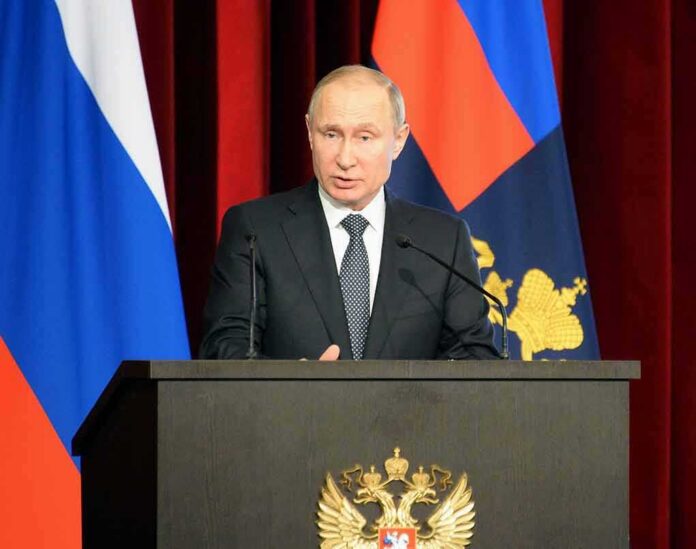
Russian President Vladimir Putin is 73 years old, has ruled for a quarter century, and has never named anyone to take his place if he dies or steps down.
Quick Take
- Putin has not publicly picked a successor, and analysts say Russia’s system offers no clear path for choosing one.
- Many senior officials who would manage a transition are also in their 70s, raising questions about long-term planning.
- Experts surveyed by Radio Free Europe/Radio Liberty mostly expect Putin to die in office or be forced out, not retire willingly.
- Analysts say any handover will likely happen through elite bargaining behind closed doors, not through public elections or laws.
No Named Heir After 25 Years in Power
The Moscow Times reported that “as far as analysts know, Putin has not hand-picked a successor”. Foreign Affairs put it bluntly: because Putin has left no chosen heir, “a struggle for power could well follow Putin’s exit from the scene.” Putin himself told a state journalist he “always considers potential successors,” but he gave no names, leaving the question wide open even at the top.
Russia’s constitution offers only a temporary fix if Putin dies or becomes unable to serve. CNN reported that neither Putin nor his inner circle have made “discernible arrangements” for what happens after his time in office ends. That leaves a legal gap. There’s a short-term rule for an emergency, but nothing that spells out how Russia would choose a real long-term leader.
An Aging Inner Circle Faces the Same Clock
The problem is not just Putin’s age. The Atlantic Council reported that Putin has moved to retire some of his most trusted, longest-serving allies, “many of whom are well into their seventies,” even as he shows “no intention of stepping down” himself. Researchers at a Swedish government-linked institute describe Russia’s leadership structure as personalized and poorly built for handoffs, making a smooth transition unlikely under current conditions.
Experts Say Death or Coup, Not Retirement
A July 2024 survey of more than 40 Russia experts found 40% expect Putin to stay in power until he dies. Another 23% predicted a “palace coup.” Just 3% thought he would leave voluntarily. That poll captures deep uncertainty more than any firm agreement, but it shows most specialists doubt an orderly exit is coming.
The Council on Foreign Relations says Russia’s next leader will likely rise from inside the existing system, through elite deal-making rather than any formal process. The report calls this a probable “top-down process set off by elite power struggles”. A separate RAND analysis lists four forces that will shape who comes next: rivalries among elite clans, the power of security services, economic strain from war and sanctions, and public discontent.
Why Outsiders Can’t See the Full Picture
Much of what is known comes from analyst commentary and expert surveys, not government documents or Kremlin admissions. No public record shows a written succession plan, a memo, or an official process. Russia’s security services and tight media control also make it hard for outsiders to tell real transition planning apart from routine political moves inside the Kremlin.
Some experts caution against reading too much crisis into the silence. The Council on Foreign Relations and RAND both frame succession as a set of risk factors, not proof that collapse is coming. Putin also keeps a tight grip through Russia’s security services, which limits how much instability the lack of a named heir actually signals right now.
A Pattern Familiar From Past Authoritarian Handoffs
Historians note this fits a common pattern in one-man rule: when a leader avoids naming an heir, power struggles often move into private rooms rather than public view. The real fight over Russia’s future is likely happening now, quietly, among a small circle of aging officials and security chiefs, most of them unnamed and unaccountable to any voter.
For a country with nuclear weapons and a war economy stretched by sanctions, the lack of any clear plan matters far beyond Moscow. Whoever eventually takes charge, and however that happens, will shape decisions that reach well past Russia’s borders.
Sources:
19fortyfive.com, sceeus.se, carnegie.ru, khodorkovsky.com, theweek.com, cfr.org, thecipherbrief.com
© patriotwise.com 2026. All rights reserved.