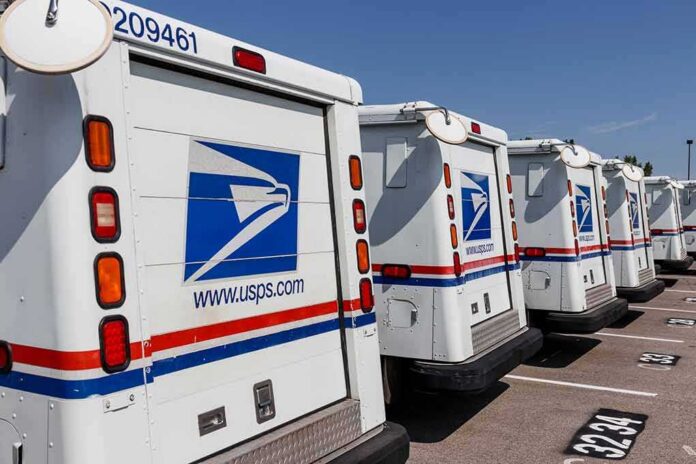
The Supreme Court blocked the Postal Service from enforcing new ballot-mail rules before the 2026 midterms, halting a last-minute federal push into how states run elections.
Story Snapshot
- The Court kept lower-court blocks in place on the Postal Service’s final ballot-mail rule.
- The rule required states to upload voter names, addresses, and barcodes to a new federal portal.
- Judges said challengers are likely to win on claims that the Postal Service lacks authority.
- The Postal Service says it can still build the portal and talk with states on a voluntary basis.
What The Supreme Court’s Move Does Right Now
The Supreme Court declined to let the Postal Service enforce its new ballot-mail rule for the 2026 midterms, leaving existing state mail-ballot procedures in place. The case reached the Court after a series of district-court orders stopped the rule. Those judges said the challengers were likely to show the Postal Service lacked power to impose these election-related steps. The order is not a final ruling on who is right. It preserves the status quo during the election period.
The rule would have added federal conditions to ballot mail. It required election offices to submit envelope designs to the Postal Service and include specific barcodes. It also required uploading the name, address, and barcode for each intended ballot recipient into a new Federal Ballot Mail Portal before the Postal Service accepted the mail. The Postal Service argued that offices already hold this data to send ballots and that the steps would improve delivery accuracy.
The Legal Clash Over Who Sets Election Rules
State attorneys general, local election officials, and advocacy groups argued that Congress and the states set election rules, not a federal mail carrier. They said no federal law lets the Postal Service refuse to deliver ballots or run a federal registry of mail voters. A federal appeals court summarized the lower court’s view: the final rule likely regulates the “manner” of elections, which the Constitution assigns to the states and Congress, not to an executive agency without clear authority.
The Postal Service and its allies framed the rule as an operational fix, not a power grab. They described registration, barcode checks, and pre-acceptance verification as standard mail-sorting tools applied to ballot mail. They told the Court the rule only conditioned acceptance on information election offices already have and use. That argument did not persuade judges at the emergency stage, who focused on the lack of explicit statutory authority to reject or delay ballot mail over portal compliance.
Operational Risks And A Rushed Timeline
The record shows the Federal Ballot Mail Portal was not ready when the Postal Service sought to enforce the rule. A senior Postal Service official said the system was not yet ready for launch but might be available for voluntary use “sometime next week”. That timing raised alarms for courts and election officials who warned that last-minute tech rollouts can cause mail delays and voter confusion. The Supreme Court’s move reduces that risk for this election cycle.
Supreme Court Rejects Proposed Mail Ballot Restrictions
• US Supreme Court blocks Trump administration's mail-in ballot restrictions for 2026 midterms.
• States may continue sending mail ballots under existing processes used for years.
• Ruling issued Monday as midterm voting… pic.twitter.com/BVc2DZ5nMf— The Unbiased Update (@unbiased_update) September 15, 2026
Even with the stay, the Postal Service says it can continue to build the portal and discuss design standards with states on a voluntary basis. That means the infrastructure work may continue in the background. But any mandatory link between ballot delivery and federal portal uploads is off the table for now. If the agency wants binding rules later, it will likely need a clear law from Congress or a court ruling upholding its authority.
Why This Fight Resonates Beyond 2026
This dispute reflects a wider pattern in election law. Presidents and agencies sometimes seek quick policy changes through rules and guidance, while courts stress that lasting election changes must come from Congress or state law. Here, critics on the left feared voter disenfranchisement and federal overreach. Skeptics on the right saw more proof that Washington’s bureaucracy can fumble basic operations and create chaos. Both worries center on trust and competence in a system many Americans feel no longer serves them.
What To Watch Next
Watch for a full Supreme Court review after the election, or for Congress to step in with clear instructions. Track whether any states engage with the Postal Service voluntarily on envelope standards and barcodes. Look for independent testing of the portal’s speed, accuracy, and cyber security. Concrete data on failure rates, scan times, and training could show whether these steps help mail reliability or just add red tape when voters most need clarity.
Sources:
atg.wa.gov, about.usps.com, news.bloomberglaw.com, supremecourt.gov, latimes.com, cbsnews.com, congress.gov
© patriotwise.com 2026. All rights reserved.