
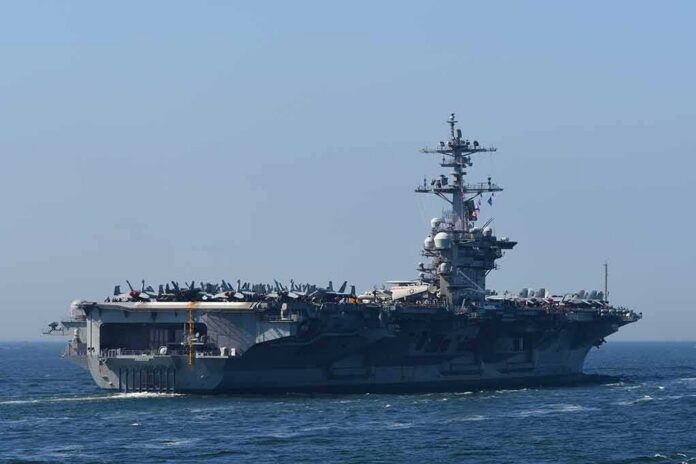
A Chinese diesel submarine surfaced within about five miles of the USS Kitty Hawk in 2006, exposing gaps in how big-deck carriers find quiet subs during peacetime drills.
Story Snapshot
- Reports say a Chinese Song-class sub surfaced near the Kitty Hawk without warning.
- A Navy aircraft, not ship sonar, spotted the sub during operations near Okinawa.
- Navy leaders later downplayed the risk and called the encounter nonthreatening.
- The episode highlights long-running challenges in anti-submarine defense for carriers.
What Happened Near Okinawa in 2006
Reuters reported that on October 26, 2006, a Chinese Song-class attack submarine surfaced within roughly five miles of the USS Kitty Hawk carrier group during operations near Okinawa. The submarine was described as undetected until it appeared near the force, prompting concern about the group’s defenses. The Washington Times likewise said the sub had shadowed the carrier before surfacing inside torpedo range, based on unnamed defense sources. Both accounts framed the encounter as a warning about quiet diesel subs.
A United States Navy spokesperson later said a United States aircraft, not ship sensors, identified the Chinese submarine, and that the two sides did not interact. She added that both forces operated in international waters at the time. A maritime policy brief summarizing open reporting said the submarine surfaced within five miles of the group and noted the sighting came from carrier-based aircraft. Details such as exact detection timelines and sensor performance were not released by the Navy.
How the Navy Characterized the Risk
Days after headlines warned of a near-shootout, the Chief of Naval Operations, Admiral Mike Mullen, rejected that idea. He said the Chinese submarine was not viewed as a threat and that such operational issues would not be discussed in public detail. Later reporting noted that Chinese officials described the event to United States counterparts as a “chance encounter,” denying any intent to stalk the carrier. Officials on both sides kept the discussion narrow and avoided technical specifics.
This gap between public alarm and official caution is common in undersea incidents. Governments often protect tactics, sensors, and patrol patterns. That secrecy leaves citizens to parse secondhand accounts and leaks. For people on the right and left who already distrust Washington, the silence can feel like stonewalling. The facts on record show a real, close approach by a foreign submarine, paired with minimal transparency about how a premier United States force handled it.
Why Quiet Submarines Still Pose Headaches
Carrier strike groups use layered defenses, but quiet submarines can still slip close, especially in busy seas and complex water conditions. Analysts have long warned that the carrier air wing lacks strong, carrier-based tools to search, track, and attack subs far from the ship, forcing reliance on offboard patrol aircraft and escorts. That structural gap complicates peacetime patrols and training, when strict rules of engagement and safety limits reduce aggressive tracking.
In 2006 a Chinese submarine surfaced undetected just 5 miles from the USS Kitty Hawk, despite it being accompanied by a full battle group including anti-submarine helicopters. Easily within torpedo strike range. pic.twitter.com/VKZsJBuh14
— SweetMarie (@Oceanbreeze473) August 9, 2026
The Kitty Hawk episode fits a broader pattern. Past Cold War and post–Cold War incidents show that carriers and submarines shadow each other, test reactions, and sometimes get too close. That history does not prove a meltdown in United States defenses, but it does show a persistent problem that spans decades and different navies. The public takeaway is simple: in the undersea game, even top fleets can be surprised, and the system rarely explains why in plain terms.
What This Means Today
Two truths can live together. First, the 2006 event was real and close enough to matter; press accounts and Navy comments confirm that. Second, senior leaders said it did not imply an immediate threat or a near clash. For voters who see Washington’s institutions as slow and self-protective, the lesson is about priorities. Clear plans to strengthen anti-submarine defenses, including carrier-based sensors and air assets, are the measure that counts now—not slogans or spin.
Sources:
19fortyfive.com, military.com, focus.de, stripes.com, en.wikipedia.org, theaviationgeekclub.com, history.navy.mil, nationalinterest.org
© patriotwise.com 2026. All rights reserved.