

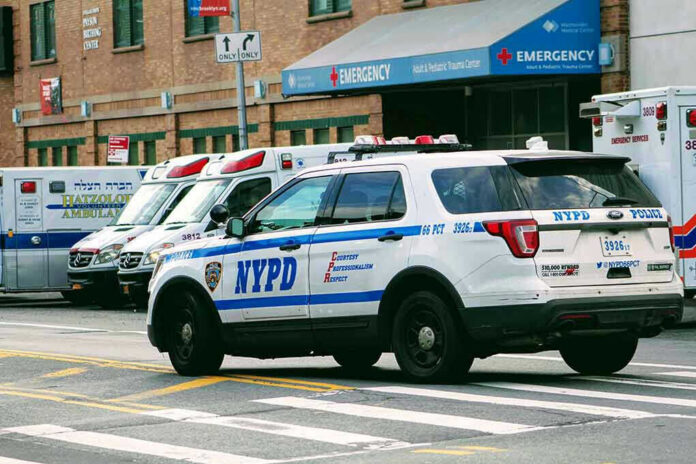
A 66-year-old rabbi was beaten on a Brooklyn sidewalk in a 20-second attack that police say followed another random assault minutes earlier.
Story Snapshot
- Police arrested Eric Avrutov, 31, after two alleged assaults minutes apart in Brooklyn.
- Video shared by a community safety group shows the 20-second attack on the rabbi.
- Police said the rabbi’s assault was not being investigated as a hate crime at this time.
- The rabbi was hospitalized in stable condition at Maimonides Medical Center.
What Police Say Happened On Dahill Road
New York City police said Eric Avrutov, 31, attacked a 66-year-old rabbi on Dahill Road near Cortelyou Road around 9:20 p.m. in the Kensington and Borough Park area. Video circulated by Boro Park Shomrim appears to show a brief confrontation and several strikes before the assailant runs off. Officers arrested Avrutov and charged him with assault, criminal obstruction of breathing, and harassment, though exact charge degrees were not listed in reports. The rabbi was taken to Maimonides Medical Center and was in stable condition.
Police also linked the case to an earlier incident. About five minutes before the rabbi was attacked, a 60-year-old man at a nearby gas station was punched while he pumped gas, according to the same reports. Authorities treated that as a separate assault and harassment case. The two events took place within a short walk and time span, which helped investigators connect them to the same suspect.
How The Case Is Classified Right Now
Police told reporters the assault on the rabbi was not being investigated as a hate crime at this time. That status can change if new evidence emerges, but no such update had been reported in the sources reviewed. New York law requires clear signs of bias in the choice of the victim or in the act itself before adding hate-crime charges. Officials often wait for witness statements, clearer video, or other evidence before making that call.
New York City guidance explains that a hate crime is when someone commits an offense and targets a person in whole or substantial part because of the person’s religion, race, or other protected traits. That legal test focuses on motive and selection, not just who the victim is or where the act happened. Prosecutors must weigh proof that would hold up in court, which can take time to collect and review.
Why This Hits A Nerve In Brooklyn
Community fear is already high because anti-Jewish assaults in Brooklyn rose sharply last year. The Anti-Defamation League reported that Brooklyn saw 50 antisemitic assaults in 2025, a 56 percent jump from 2024. Orthodox Jews were targeted in a large share of those attacks, and the borough remains a hotspot for such incidents compared with other parts of the city and state. That pattern makes each new assault feel less random, even when police have not found bias evidence yet.
This tension puts both safety and due process in the spotlight. Many residents want faster hate-crime screenings and tougher responses. Others warn against rushing legal labels without proof. City and state rules aim to balance both needs. They urge quick documentation of possible bias signs while holding charges to evidence that can survive in court. That is why early statements often flag a case as “not at this time,” pending more facts.
Accountability, Public Safety, And What Comes Next
Reports said Avrutov had five prior arrests, including a similar incident two days earlier, though those cases were not detailed in the public record cited here. That detail fuels a familiar complaint across the political spectrum. People ask why repeat violent offenders are on the street and why basic protection often fails. The right points to weak enforcement and revolving-door courts. The left points to gaps in mental health care and strained city services. Both sides want fewer victims and faster action.
Eric Avrutov, 31, allegedly cornered the 66-year-old religious leader without warning and dealt multiple blows on Dahill Road near Cortelyou Road in Kensington around 9:20 p.m.
He was charged with assault, criminal obstruction of breathing and harassment.
The act is not being… https://t.co/nlkJNvZ8zu
— Crime In NYC (@Crime_In_NYC) September 25, 2026
What to watch now is simple. First, how prosecutors charge the case after full review. Second, whether new evidence shifts the hate-crime analysis. Third, whether the court addresses any pattern of repeat arrests tied to violence. Brooklyn residents need a clear plan that blends firm law enforcement with smart prevention. New York has tools on the books. The test, once again, is whether the system uses them in time to keep people safe on their own block.
Sources:
nypost.com, jpost.com, israelnationalnews.com, brooklynda.org
© patriotwise.com 2026. All rights reserved.