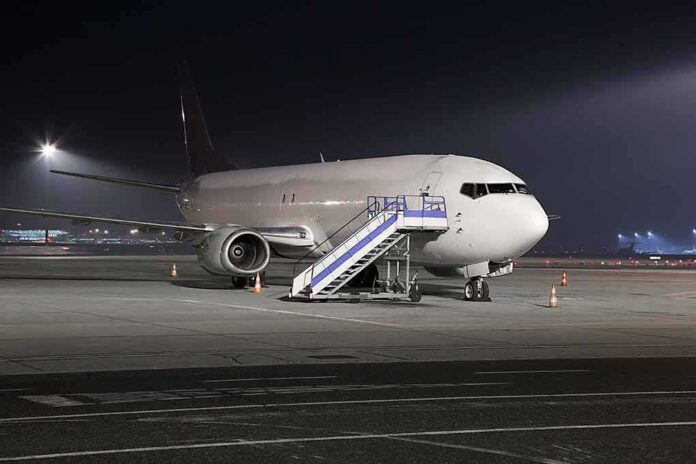
A brutal cockpit attack on a Dubai-to-Tel Aviv flight was stopped midair by passengers, crew, and off-duty pilots, preventing a mass-casualty crash.
Story Snapshot
- Israeli officials say a co-pilot stabbed the captain and tried to crash a Flydubai jet before an emergency landing in Saudi Arabia.
- Passengers, crew, and two off-duty pilots entered the cockpit and helped stabilize the plane for a safe landing in Tabuk.
- Both pilots were injured; Saudi authorities detained the suspect and began questioning him.
- The incident highlights rare but serious “insider” cockpit threats and renewed calls to review screening and access rules.
What Happened On Board Flight FZ1073
Israeli Prime Minister Benjamin Netanyahu said a co-pilot stabbed the captain on a Flydubai flight from Dubai to Tel Aviv and “apparently tried to crash the plane.” Passengers and crew forced entry into the cockpit, fought the attacker, and helped regain control as the jet descended sharply. The aircraft diverted to Tabuk, Saudi Arabia, and landed safely. All passengers survived, while both pilots were hurt and treated after landing, according to multiple outlets and Israeli officials.
Netanyahu praised the wounded captain, identified in several reports as Smit Machchhar, calling him a hero for actions that saved 174 people, according to a detailed account provided to Reuters. An Israeli spokesperson told Reuters the captain was “covered with blood” when he managed to release the cockpit door, allowing others to subdue the attacker and enabling two off-duty Flydubai pilots on board to assist with the landing in Tabuk. Saudi authorities took the suspect into custody.
How The Plane Recovered And Landed Safely
Witness accounts and official summaries state the jet rapidly lost altitude before the situation stabilized. The plane then diverted to Prince Sultan bin Abdulaziz Airport in Tabuk, where it executed an emergency landing. Reports describe coordination between cabin crew, passengers, and the extra pilots to secure the cockpit and control the aircraft. After landing, injured crew received care, and investigators began interviews and evidence collection under Saudi jurisdiction.
Major news outlets described a chaotic but swift response that turned a near-disaster into a controlled emergency. Several reports noted the presence of additional Flydubai pilots traveling on the flight who could help fly the jet after the struggle. That redundancy, plus the quick action by trained crew and willing passengers, likely prevented worse outcomes. Official tallies indicated all passengers survived the ordeal without reported life-threatening injuries.
Why This Rare Threat Matters For Air Safety
Cockpit violence by insiders is rare but not new, and it triggers the toughest questions in aviation. Security reforms after the September 11 attacks focused on keeping intruders out, but this event came from within the locked flight deck. Analysts say the case fits a known pattern called “crew-related interference,” where a crew member creates a flight emergency and is restrained before a safe diversion. That pattern has prior examples and remains a top-risk scenario to plan for.
The incident also spurred fresh attention on emergency codes and public confusion during fast-moving events. Aviation guides explain that pilots use specific transponder codes to signal different emergencies. A code for hijacking exists, and another code covers general distress. These tools help controllers respond quickly. But outside audiences sometimes misread these signals in real time, which can fuel panic before facts are confirmed by officials and airlines.
What Changes May Come Next
Investigators will examine pilot screening, mental health checks, cockpit access protocols, and how many people can safely reenter the flight deck during a crisis. Airlines and regulators often review training for crew teamwork, restraint techniques, and rapid handover of controls. Safety experts also look at how extra qualified pilots on board can improve resilience. Early reporting already highlights new calls to update cockpit procedures and reinforce the human factors that kept this flight in the air.
Israeli Prime Minister Benjamin Netanyahu met passenger Yaniv on Wednesday and praised him as he helped restrain a pilot during the reported cockpit attack aboard a Flydubai flight bound for Tel Aviv. Yaniv was among the passengers who entered the cockpit and helped restrain the… pic.twitter.com/3oKAetdrHH
— News9 (@News9Tweets) October 1, 2026
Many readers across the political spectrum see a deeper pattern here. Strangers and crew stepped up, acted fast, and did the job when institutions were far away. That outcome pushes against the sense that large systems are slow, opaque, and distant. The people on board did what we ask of good citizens: stay calm, take action, and protect others. In a time of doubt about leaders and agencies, that is a clear reminder that courage and skill still matter most.
Sources:
facebook.com, theguardian.com, bbc.com, jpost.com, arabnews.com, pbs.org, thehill.com, latimes.com
© patriotwise.com 2026. All rights reserved.