

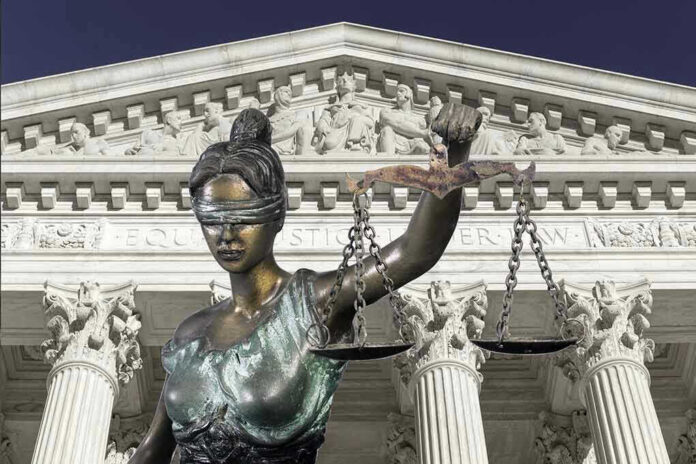
The Supreme Court has agreed to hear a landmark case that could fundamentally reshape Second Amendment protections by determining whether federal laws can strip gun rights from Americans who use drugs.
Story Highlights
- Supreme Court will review constitutionality of 1968 federal law banning drug users from owning firearms
- Case involves Ali Danial Hemani, charged for gun possession despite alleged marijuana and cocaine use
- Fifth Circuit Court already ruled the prohibition unconstitutional, creating legal precedent
- Decision could impact millions of Americans and reshape gun control policies nationwide
Constitutional Challenge Reaches High Court
The Supreme Court accepted a pivotal Second Amendment case challenging a federal prohibition that bars unlawful drug users from possessing firearms. The case centers on Ali Danial Hemani, a dual U.S.-Pakistan citizen indicted in 2023 for violating the drug-user firearm ban due to alleged habitual marijuana and cocaine use. This represents a direct test of whether the 1968 Gun Control Act’s restrictions violate constitutional protections for law-abiding gun owners.
The Fifth Circuit Court of Appeals ruled in Hemani’s favor in 2024, declaring the federal prohibition unconstitutional unless defendants were under the influence during arrest. This decision created a significant legal precedent that conflicts with federal enforcement priorities. The Trump administration now faces defending a law that potentially infringes on fundamental constitutional rights while balancing legitimate public safety concerns.
Historical Context and Legal Framework
The challenged law stems from the 1968 Gun Control Act, which broadly prohibits individuals addicted to or unlawfully using controlled substances from owning firearms. Historical precedents show similar restrictions applied to groups like drunkards, but modern constitutional interpretation demands stricter scrutiny of such limitations. The Supreme Court’s 2022 decision protecting public carry rights established new standards requiring gun restrictions to align with historical and traditional firearms regulation principles.
Legal scholars note this case intersects critical issues of individual liberty, constitutional interpretation, and government overreach. The law’s broad language potentially criminalizes millions of Americans who may use substances legally in their states but remain federally prohibited. This creates a troubling scenario where law-abiding citizens face federal prosecution for exercising fundamental constitutional rights, highlighting the tension between federal control and individual freedoms.
Constitutional Rights Under Attack
Solicitor General D. John Sauer argues the law targets individuals posing clear dangers due to drug impairment, but this reasoning raises serious constitutional concerns. The prohibition applies regardless of actual impairment, creating a permanent disability based on alleged substance use rather than demonstrated unfitness or criminal behavior. This broad approach undermines core Second Amendment principles that protect individual rights from government infringement without compelling justification.
The US Supreme Court will consider whether being a pot smoker could make it illegal for you to own a gun. Is this a clear violation of the Second Amendment? Read more: https://t.co/JgJGLp9YDc pic.twitter.com/6qIM0WTTV8
— FOX59 News (@FOX59) October 20, 2025
The case scheduled for January arguments could reshape gun control policies nationwide and influence how states regulate firearms for drug users. A ruling against the federal prohibition would strengthen individual gun rights and limit government authority to impose blanket restrictions on constitutional freedoms. Conversely, upholding the ban could encourage further erosion of Second Amendment protections through expanded prohibited categories targeting law-abiding Americans.
Sources:
Supreme Court will decide on guns rights for drug users
Supreme Court to decide constitutionality of law barring illegal drug users from having guns